The visitor to the website of a farm, an estate or a coffee roaster has often tasted already: at the market, at a wine shop, at friends’. They come back to know where to buy, when to come by, what is in season. Others are discovering: they want to see the place and understand how it is made.
The place of production is your first argument: the page shows it, then says how to come and get the products.
What the customer comes looking for
In 2020, 23.1% of farms in mainland France sold part of their production through short supply chains, and direct sales at the farm were the most common form (Insee, 2024, from the agricultural census). The customer looking for you first wants to know how to buy from you.
- Where and when: the days and hours of farm-gate sales, the markets you attend, with the day and the square.
- What there is now: the season’s products, what is missing, what is coming.
- The prices, at least those of the usual products.
- The place and the way of working: the plots, the livestock, the cellar, the drying room, the roastery.
- Quality labels: organic, PDO, PGI, Label rouge, and what they guarantee.
- Access: directions to the farm, and where to park.
The “Producer” layout
The studio offers it to farms, estates and roasters, whose place of production is the argument. Here it is from top to bottom:
“Producer” layoutBackground: Looping videoTexture: GrainTexture: Vignetting
 Full bar
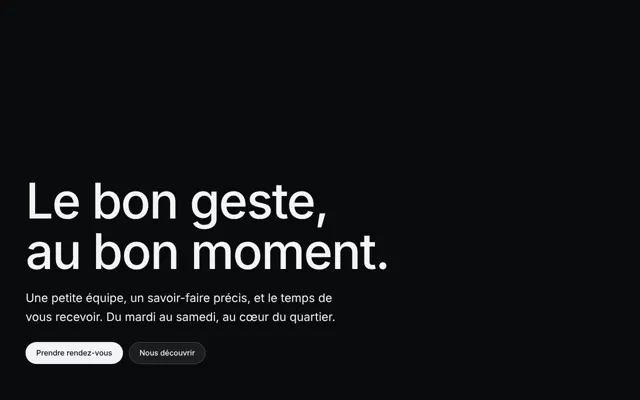 Hero · Bottom left
 Manifesto
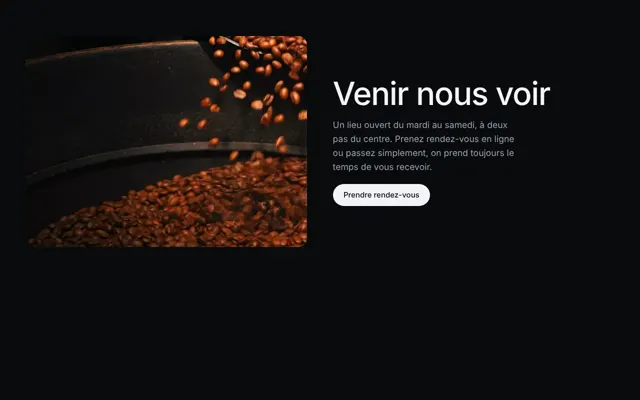 Split · Edge to edge
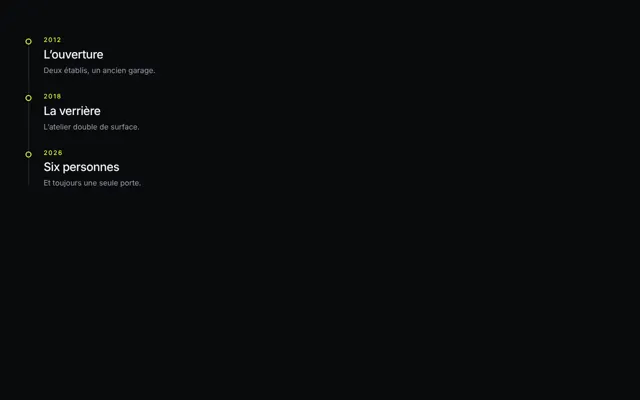 Timeline
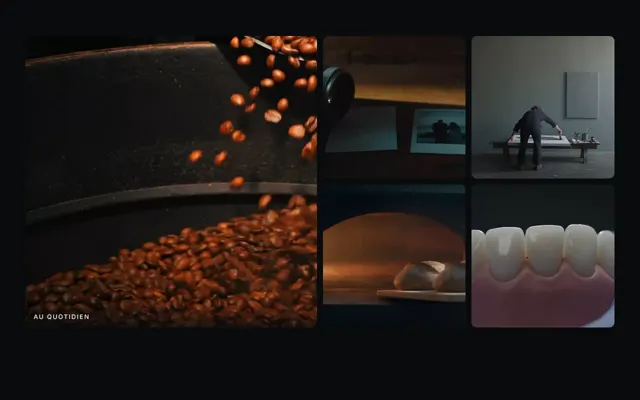 Gallery · Landscapes
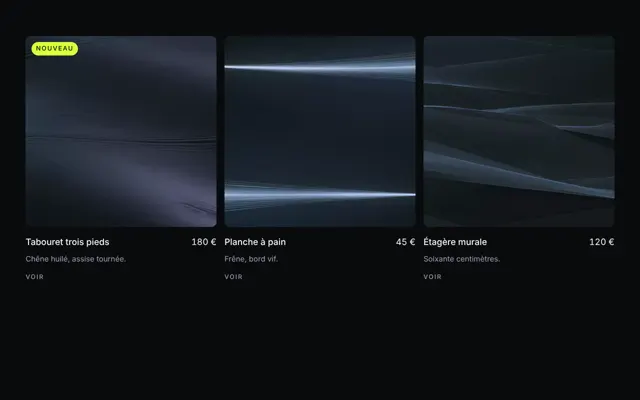 Products
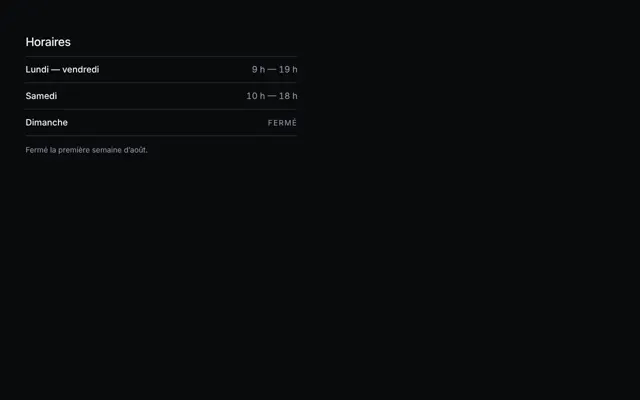 Opening hours
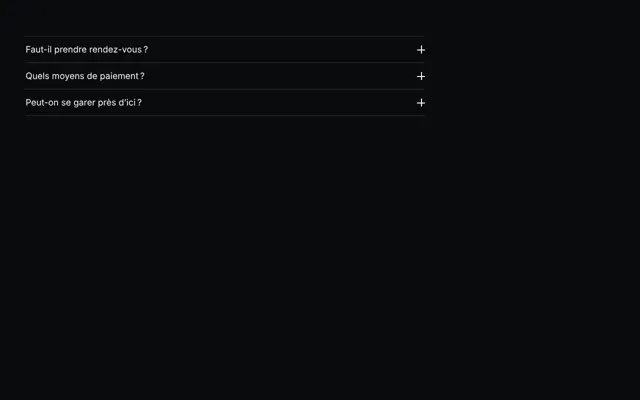 Accordion
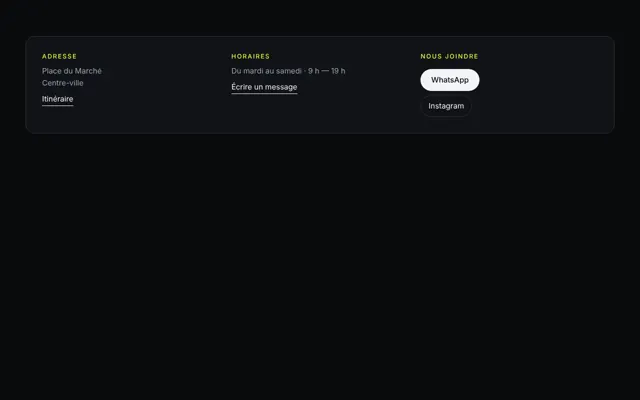 Contact
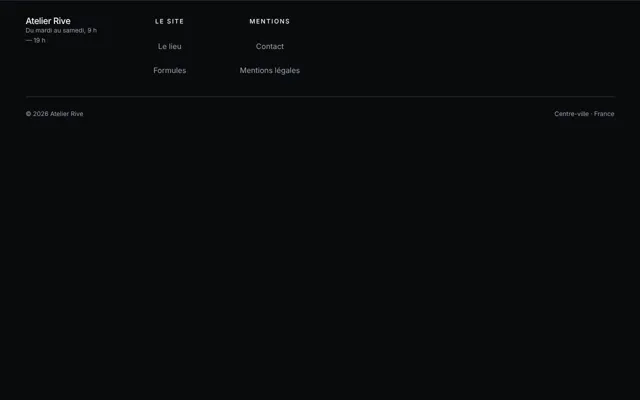 Footer
- The full bar has an opaque background: your name and your button read from the first image.
- The bottom-left hero sets the name and a sentence at the bottom left, where the video leaves room. Its button leads to the sales hours or to directions.
- The manifesto holds a sentence on screen and lights it up word by word as you scroll. Only one per page: your way of working, said once.
- The edge-to-edge split sets a photo against the edge of the screen and the text beside it: the plot, the herd, the person.
- The landscape gallery takes the format of places: the fields, the rows of vines.
- The accordion answers the questions that keep coming back, three to six of them: do I need to order, can I visit, where to find you at the market.
- The contact brings together the address, the sales hours and the phone as real links.
- The footer says who you are and carries the legal notice.
The background chosen is the looping video: a slow shot that plays endlessly, and the elements rise over it. Grain and vignetting go with it: the first breaks up the flat areas of a generated image, the second darkens the edges. The background is a scene created from your description, a vineyard at sunrise or a barn: it sets the mood, and your real plots go in the gallery.
What the rules say
The Évin law, for a wine estate or a brewery
In France, alcohol advertising has been allowed on the internet since 2009 (National Academy of Medicine, 2012). It remains forbidden on sites mainly aimed at young people and on those of sports associations or federations, and it must be neither intrusive nor interstitial (Ministry of Health, 2014).
Its content is limited: the alcohol content, the origin, the name, the composition, the producer’s name and address, the method of production, the terms of sale and the way of drinking it. All advertising carries the health message “L’abus d’alcool est dangereux pour la santé” (alcohol abuse is dangerous for your health). The law applies to the site as well as to social networks (Ministry of Health, 2023).
Since 2016, content about a production region, a terroir, the know-how, the history or the heritage linked to a drink with a quality or origin label is no longer considered advertising (article L3323-3-1 of the Public Health Code, cited by the ARPP, 2016).
For an estate’s website, that means:
- show the vines, the cellar, the harvest: that is terroir and know-how, and the right subject for the background;
- describe each cuvée by its objective elements: appellation, grape variety, alcohol content, method;
- leave aside scenes of partying, seduction or sport around a glass, which fall outside that list;
- place the health message, readable, near the cuvées and in the footer.
Organic, PDO, farmhouse: controlled words
The official labels (PDO, PGI, Label rouge, organic farming) rest on a specification checked by certification bodies approved by the INAO, and the DGCCRF inspects products placed on the market. For organic, each operator notifies its activity to the Agence Bio and is inspected at least once a year; only a product with at least 95% organic agricultural ingredients carries “organic” in its name (DGCCRF, 2025).
The word “fermier” (farmhouse) is regulated too: according to case law, it implies production integrated into the farm, traditional methods and ingredients coming mostly from the farm itself (DGCCRF, 2025).
On the site, name the label product by product. If only part of the farm is certified, say which part. Displaying a label you haven’t obtained is a misleading practice in all circumstances (DGCCRF, 2025).
Farm-gate sales and markets
Write the days and hours of farm-gate sales, then your markets: the day, the town, the square. If it changes with the season, say so, and change the page the same day as your Google profile.
Display prices as at the market, in euros and tax included. For most prepackaged food products, the price per kilo or per liter accompanies the selling price (DGCCRF, 2026).
The hero button leads to the most useful thing: directions to the farm, or your number. If you already take orders with another tool, it can lead there; the studio doesn’t take any itself.
The mistakes that cost visits
- Outdated market days: the customer makes the trip for nothing.
- “Organic” or “farmhouse” written for the whole farm, when only part of the products qualifies.
- An estate without a health message, or images of partying around wine.
- Stock photos: any old field says nothing about your land.
Sources
- Insee and SSP, Changes in agriculture and food consumption, factsheet 1.8 (2024, from the 2020 agricultural census)
- French Ministry of Health, answer to written question no. 53474, National Assembly (Official Journal of November 4, 2014)
- French Ministry of Health, answer to written question no. 5417, National Assembly (Official Journal of December 12, 2023)
- French National Academy of Medicine, Alcohol advertising: for a return to the spirit of the Évin law (2012)
- ARPP, Shared reading of article 13 of the law of January 26, 2016 (2016)
- DGCCRF, Official signs of quality and origin for food products (2025)
- DGCCRF, Misleading commercial practices: how to recognize them (2025)
- DGCCRF, Price information (2026)