
People look for a joiner, a potter or a soap maker in two ways. For a building job, they compare: they want to see past work, know whether the craftsperson comes out to them, and make sure they are insured. For a handmade piece, they come to see the material, the hand that works it, and where to buy it.
In both cases, the visitor is cautious: they are entrusting their home or their money to a stranger. The site shows them the work, then gives them what they need to check.
What the customer comes looking for
- The work done, in real photos, with the place, the year and the material.
- The area and lead times: the towns where you work, the wait before an appointment or an order.
- The guarantees: your insurance, your status as a craftsperson, your qualifications.
- The price, or its logic: an order of magnitude, what makes the bill vary, and the price of the quote if it is charged: in France that price must be displayed (DGCCRF, 2026).
- The contact: the phone, which people tap to call, and the workshop address with its opening hours.
The “Craft workshop” layout
The studio offers it to joiners, potters, soap makers: trades where the material and the gesture convince better than a sales pitch. Here it is from top to bottom:
“Craft workshop” layoutBackground: Looping videoTexture: GrainTexture: Vignetting
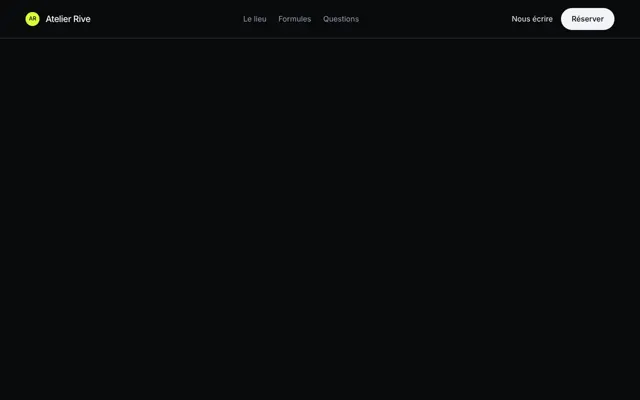 Full bar
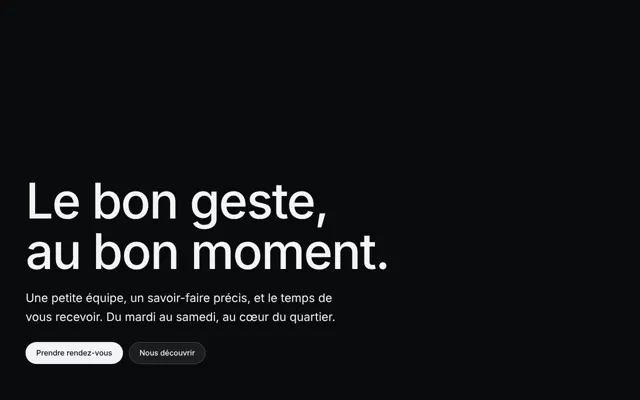 Hero · Top left
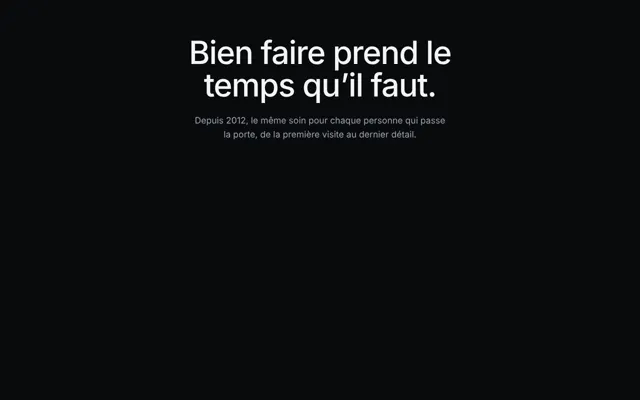 Statement
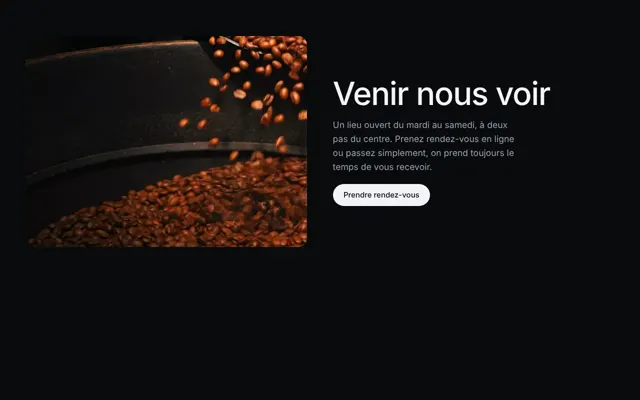 Split · Edge to edge
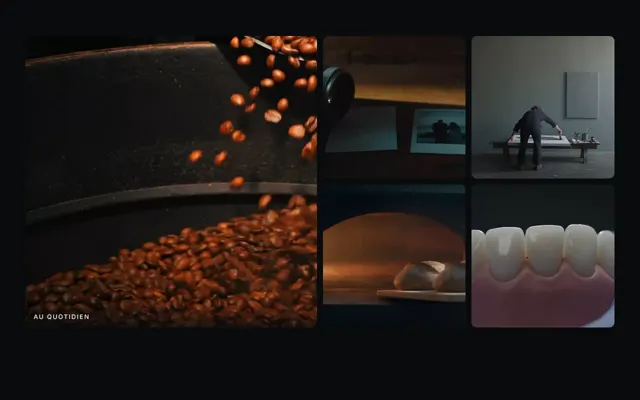 Gallery · Mosaic
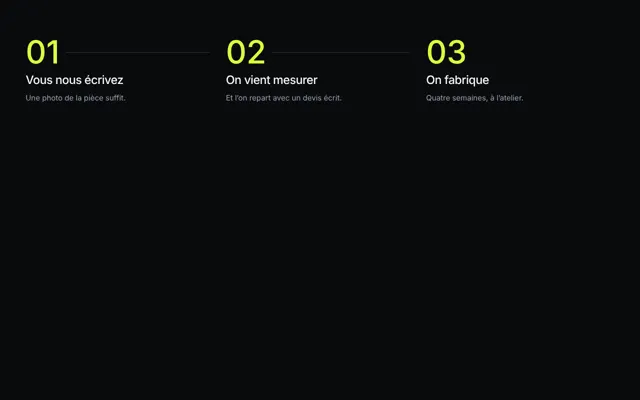 Steps
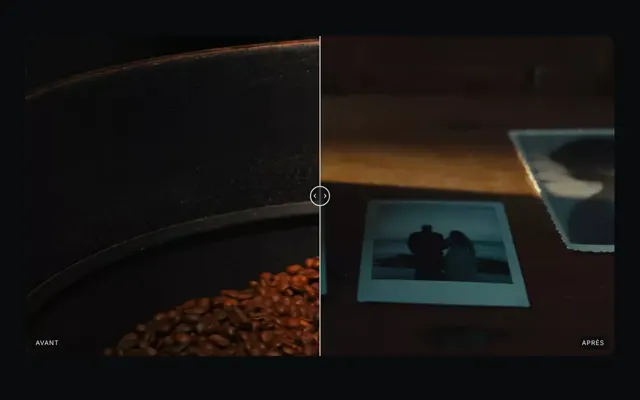 Before / after
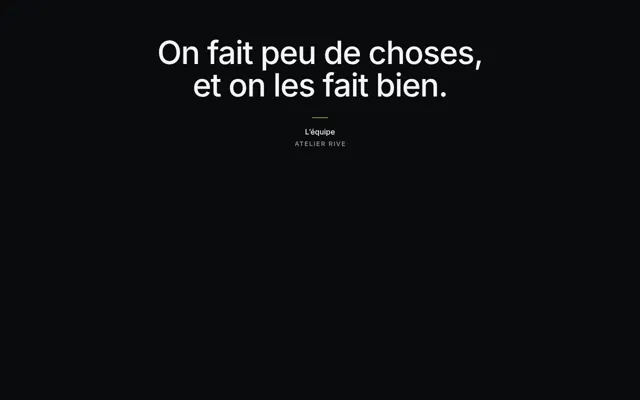 Quote
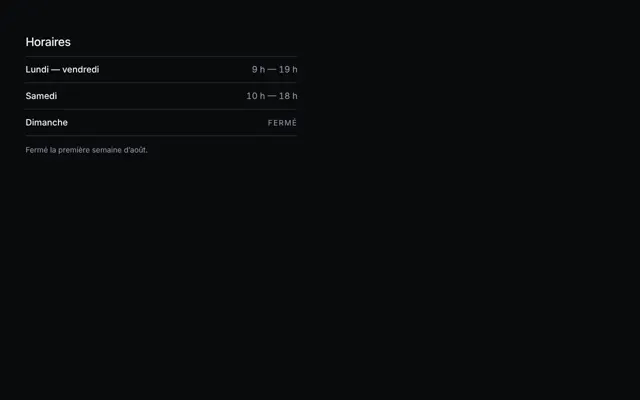 Opening hours
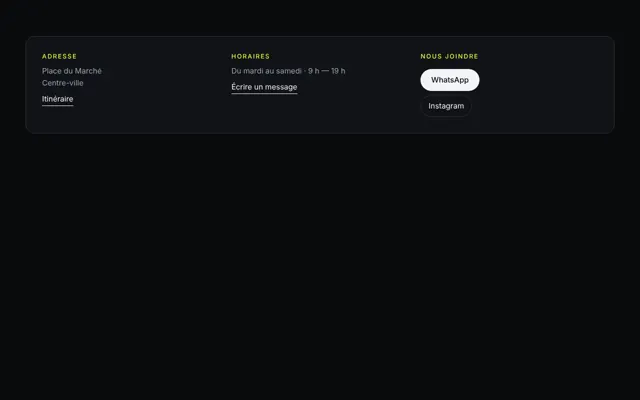 Contact
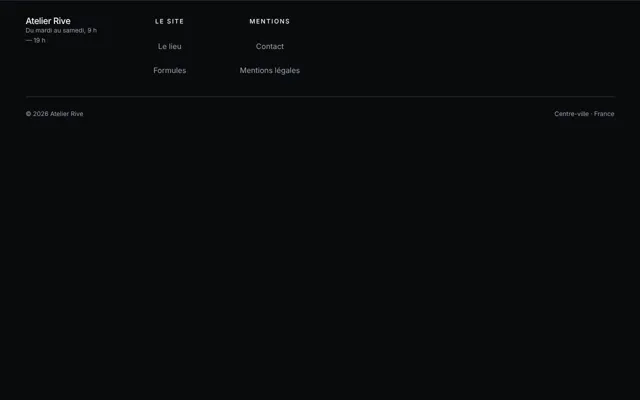 Footer
- The full bar has an opaque background: your name and your button read from the first image.
- The top-left hero sets your name and your trade at the top of the screen, and leaves the bottom to the filmed gesture. Its button leads to the quote or the phone.
- The statement says in one sentence what sets you apart: oak from nearby forests, wood firing, cold-process soap.
- The edge-to-edge split sets a photo against the edge of the screen and the text beside it: your workshop, your way of working.
- The mosaic gallery shows your work in an irregular composition. It needs 5 or 9 images, otherwise the last row is left orphaned.
- The before / after stacks two states of the same frame, separated by a handle the visitor moves: the sideboard before and after its restoration. The two photos have exactly the same framing, otherwise the comparison lies.
- The quote carries a whole sentence with its attribution: a customer’s words, with their consent, or your own.
- The contact brings together the address, the hours and the phone as real links.
- The footer says who you are and carries the legal notice.
The background chosen is the looping video: it plays endlessly behind the page, and the elements rise over it as you scroll. Two textures go with it: grain, a film noise that breaks up the flat areas of a generated image, and vignetting, which darkens the edges to gain contrast without touching the video.
What the rules say
Ten-year insurance, for those who build or renovate
In France, a joiner who fits windows and doors works on the building: they must hold ten-year liability insurance before opening the job. This guarantee covers, for ten years after the works are handed over, defects that threaten the soundness of the structure or make it unfit for use, within the activities declared to the insurer. The certificate is given to the customer before the job and attached to the quote as well as the invoice (Service-public.fr, 2026).
The DGCCRF also lists professional insurance among the information a provider must give or make available to the customer before the contract, with the insurer’s name and the geographic coverage (DGCCRF, 2026). One line in the contact or the footer of the site is enough, with the activities covered.
A potter or a soap maker selling their pieces is not concerned.
The word “artisan” has to be earned
To call yourself an artisan in France, two conditions apply: being registered in the national business register, and having a manager with a CAP, a BEP or an equivalent qualification in the trade, or three years of experience. The rule applies to derived words, such as “artisanal”. Calling yourself a “master” of a trade without the title of master craftsperson, awarded by the chamber of trades, can be judged misleading. Using the word without holding the status is punished by a €7,500 fine, and the DGCCRF can require you to correct your website (DGCCRF, 2026).
RGE, for energy renovation
The RGE label, for “recognized environmental guarantor”, covers energy improvement works and renewable energy: insulation, glazing, heating. Without it, your customers are entitled neither to MaPrimeRénov’ nor to the zero-interest eco-loan. It is granted for four years, with a check every year, per field of work. To keep it, the company informs its customers that it holds it, on a durable medium, with the certifying body’s proof (Bercy infos, 2026).
On the site, write the exact field and the name of the body, without widening it. Displaying a label you haven’t obtained is a misleading commercial practice in all circumstances (DGCCRF, 2025).
The gesture on video
The background of a site built in the studio is shot by a video generation model, from the scene you describe: shavings falling from a plane, a lump of clay on the wheel. The scene is created: it gives the light and the rhythm of the trade, without showing your pieces.
So present it as an atmosphere. French consumer law counts as misleading a presentation that deceives about how a product is made, and the DGCCRF cites the case of a soap called “natural” when its manufacturing doesn’t allow it (DGCCRF, 2025). Your real pieces go in the gallery and the before / after, in photos.
For the scene, describe the gesture, the tool and the material: see describing a scene for AI. If the visitor has asked for less animation, the video fades out and its poster stays.
The mistakes that cost jobs
- Stock photos in place of your work: the customer is looking for your work.
- A gallery without captions, neither place nor year: a photo alone proves little.
- “Artisan” or “RGE” written without holding the status, or a widened RGE field.
- The number as an image, which can be neither tapped nor copied.
- An invented or edited review: see customer reviews on your site.
Sources
- DGCCRF, Artisan: use of the word and the title (2019, updated 2026)
- Service-public.fr, Builders’ ten-year guarantee (checked April 2026)
- DGCCRF, Pre-contractual information (2019, updated 2026)
- DGCCRF, Price information (2026)
- Bercy infos, Building professionals: how to obtain the RGE label (2026)
- DGCCRF, Misleading commercial practices: how to recognize them (2025)