
Three visitors arrive on a training provider’s website. An employee preparing a career change, looking at what her personal training account (CPF) can pay for. An HR manager who has to train a team and go through their skills operator. A parent looking for private lessons for a teenager. All three compare: the program, the price, the dates, the funding.
They also arrive wary. Years of calls and texts about the CPF have taught everyone that a training course is checked before it is bought. Your site is where that check happens.
What the learner comes looking for
- The program: the objectives, the content, the prerequisites, the duration.
- The price, and how to fund it.
- The dates and the format: in person, remote, in a small group, the time before starting.
- The results: exam pass rates, satisfaction, what former trainees go on to do.
- Your reliability: the declaration number, the Qualiopi certification, the trainers, accessibility for disabled people.
The “Training” layout
The studio offers it to schools, training bodies and private tutors: the program, the price, and the questions that keep coming back.
“Training” layoutBackground: Looping videoTexture: Grain
 Full bar
 Hero · Centered
 Numbered list
 Tabs
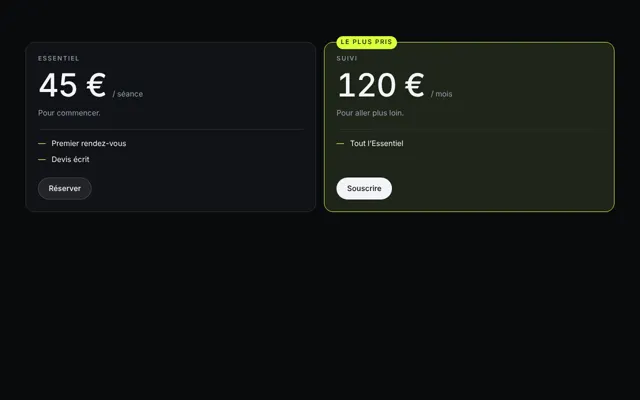 Pricing · Rows
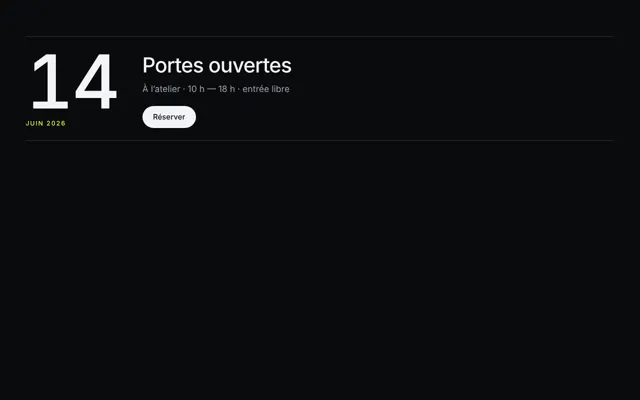 Event · Inline
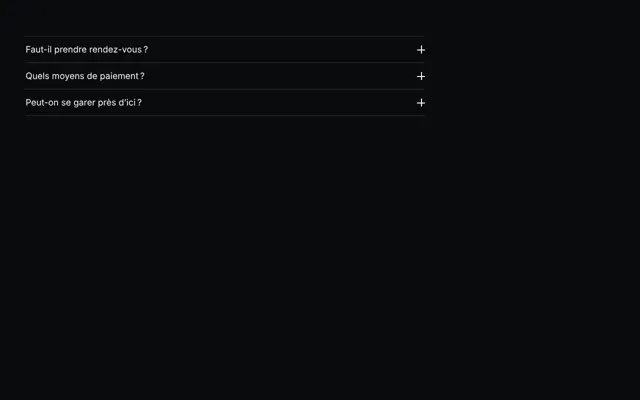 Accordion
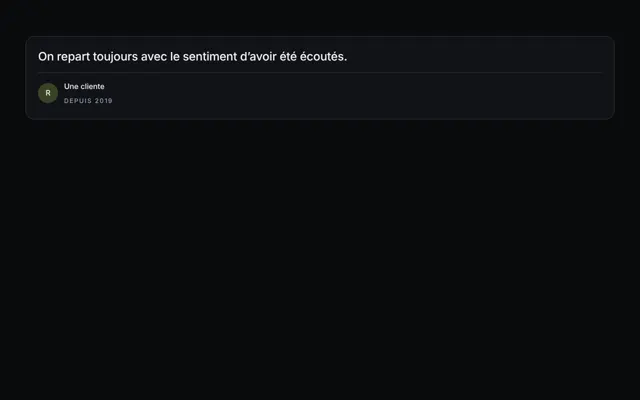 Testimonials
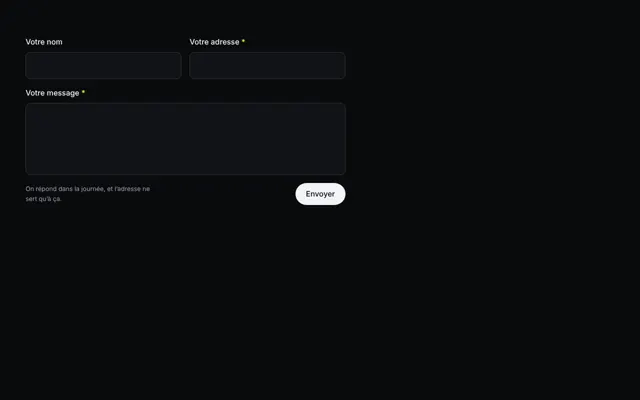 Form
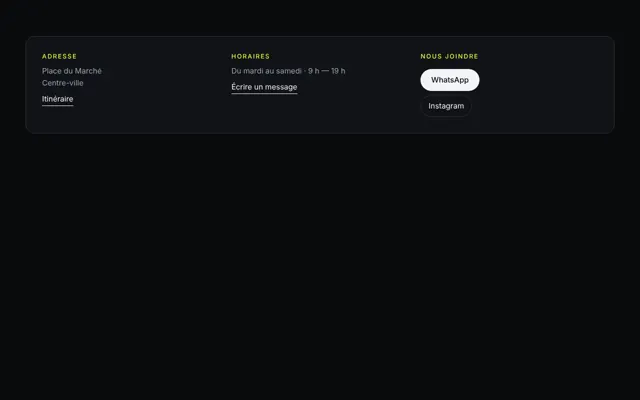 Contact
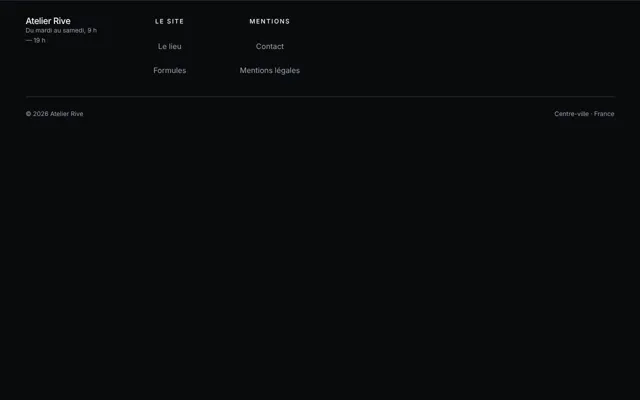 Footer
- The full bar stays opaque above the video: program, prices, questions and sign-up read from the first screen.
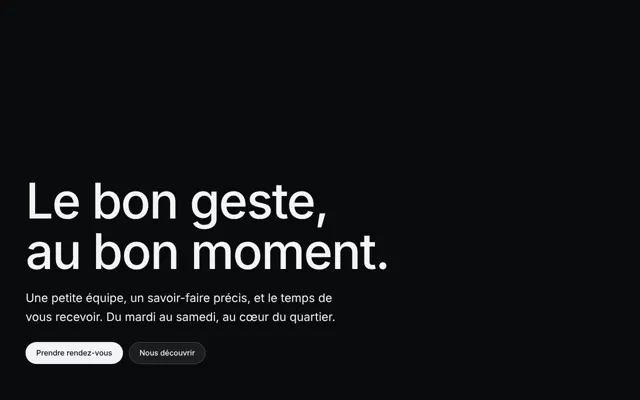
- The centered hero says what people will be able to do when they finish, in one sentence. Its button leads to sign-up or a quote.
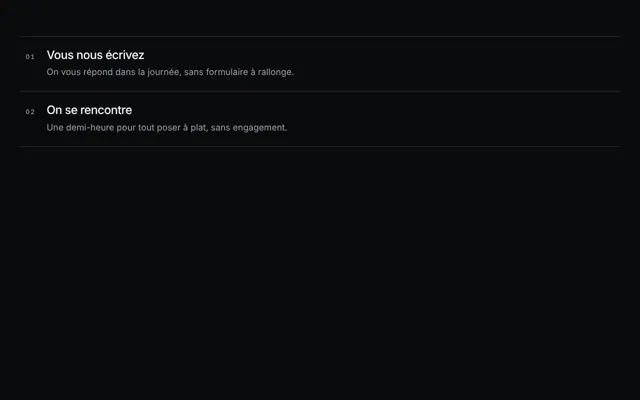
- The numbered list runs through the program, module by module, from 01 to 05.
- The prices in rows suit long price lists: one row per course or per format, with the duration and the price. Three columns would suggest three packages.
- The accordion answers what people always ask: funding, prerequisites, accessibility, cancellation, the certificate given at the end.
- The testimonials bring together several trainee reviews, dated, with the course taken. A single one would read as the seller’s own claim.
- The contact gives the address, the phone and the email as real links.
- The footer carries your declaration of activity number, the Qualiopi mark if you have it, and the legal notice.
The background chosen is the looping video, the simplest and sturdiest of the studio’s video backgrounds: a short shot, filmed from your description, which plays on its own while the blocks rise as you scroll. It is a created scene, a workshop, hands on a workbench, a lit classroom: it sets the tone without claiming to show your premises. It fades out for visitors who ask for less animation, and its poster stays. The Grain texture (see film grain) breaks up the flat areas that betray a generated image.
What the rules say
The declaration of activity. In France, anyone who delivers professional training declares their activity to the regional prefect, with the regional inspection service of the DREETS. Training without a declaration number is an offense. This number isn’t an approval: the state doesn’t validate the content of your courses. If you cite it in your communication, it comes with the statement “This registration does not constitute state approval” (DREETS Nouvelle-Aquitaine, 2026).
Qualiopi. Since the law of September 5, 2018, certification is mandatory for any provider that wants to benefit from public or pooled funds: skills operators, the state, regions, the Caisse des dépôts for the personal training account, France Travail, Agefiph. The right to use the mark comes with the certificate, after a successful initial audit.
Using the mark. The Ministry of Labor’s charter sets three rules that affect your site:
- the mark is always accompanied by the category of certified action: training actions, skills assessments, validation of prior learning, apprenticeship;
- it isn’t used in an advertisement for a particular course, nor on the certificate given to the trainee;
- no domain name may reuse or imitate the mark.
So place the logo in the footer, as part of the organization’s identity, with its statement, rather than next to the price of a module.
What the framework requires you to display. The first indicator of the national quality framework requires accessible, detailed and verifiable information: prerequisites, objectives, duration, access arrangements and lead times, prices, contacts, methods, assessment arrangements, accessibility for disabled people. The second requires results indicators. For a certifying course, the third adds the pass rate, the skills blocks, equivalences, bridges and career outcomes. The reading guide specifies that the pass rate is read together with the rate of candidates sitting the exam. The framework evolves: ask your certifier for the version that will apply at your next audit.
CPF canvassing. Since the law of December 19, 2022, it is forbidden to canvass a personal training account holder by phone, text, email or social network, except for a course already under way with you. The fine can reach €75,000 for an individual and €375,000 for a company (DGCCRF, 2026).
The “Sign up” button
The studio builds the page that presents your courses and makes people want to sign up. It sells nothing and collects nothing. The button leads to the tool you already use: the course’s page on Mon Compte Formation, your sign-up platform, your calendar, or a quote request by email. For a company, a “Request a quote” link is often enough: its skills operator will decide on funding.
The mistakes that cost sign-ups
- “State approved” for a mere declaration number.
- The Qualiopi logo without its category, or stuck to the price of a course.
- A promise of funding you don’t control: the funder decides.
- A pass rate without the number of candidates who sat the exam.
- No prerequisites or duration: the visitor doesn’t know whether the course is for them.
- Undated reviews, which suggest the course hasn’t run in years.
Sources
- DREETS Nouvelle-Aquitaine, Do I need to declare? Questions on the declaration of activity (2026)
- French Ministry of Labor, Qualiopi, the quality certification mark for training providers (2026)
- French Ministry of Labor, Charter for use of the Qualiopi mark
- French Ministry of Labor, National quality framework, reading guide, version 9 (2024)
- DGCCRF, Stronger measures against abusive canvassing (2026)