
A consulting firm’s visitor compares. A small business owner, a finance director, a mayor preparing a call for tenders opens three or four sites in the afternoon, and keeps those that understood their problem. They take their time, and they are wary: they have already paid for a report left in a drawer, or waited for accounts delivered late.
What they look for fits in two words: method and proof. The rest, the tone, the partners’ photo, the color, serves to make those two things readable.
What the client comes looking for
- The problem you deal with, and for whom: the size of the companies, their sector, the moment you get called in.
- The method: the steps, what the client receives at each one, the duration.
- The proof: comparable assignments, what they changed, clients willing to talk about it.
- Who does the work: the partners, their qualifications, registration with the Order for a chartered accountant.
- How to start: a first conversation, a quote, an engagement letter, a price range.
The “Consulting” layout
The studio offers it to consultants, accountants and engineering firms, where the method and the figures are what count.
“Consulting” layoutBackground: CloudsTexture: Paper
 Labels
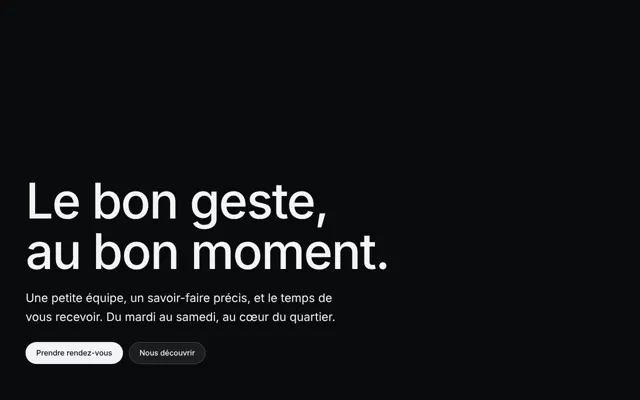 Hero · Centered
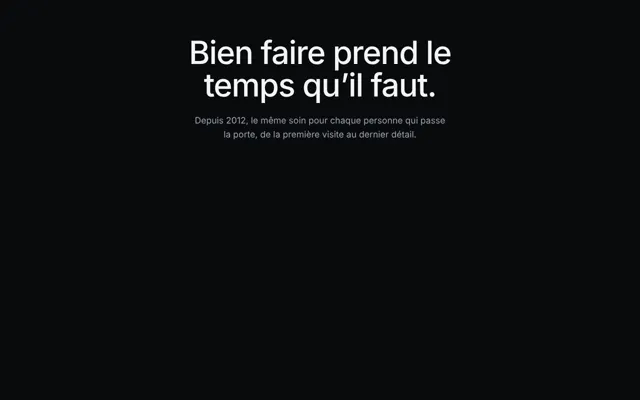 Statement
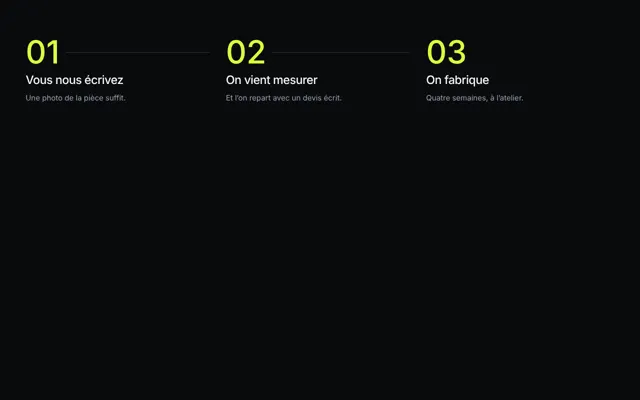 Steps · Linked
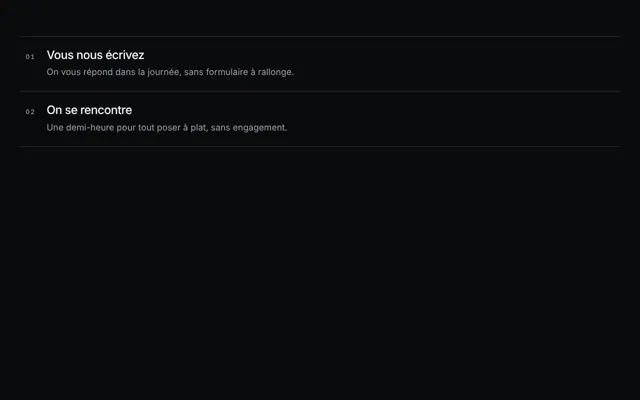 Numbered list · Filling
 Numbers · Partitioned
 Team
 Testimonials · Frameless
 Call to action · Boxed
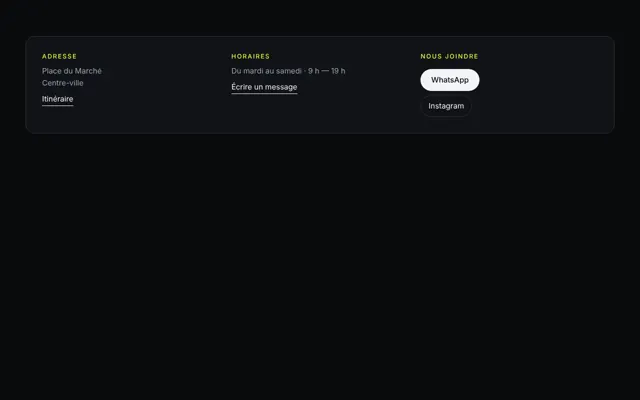 Contact · Panel
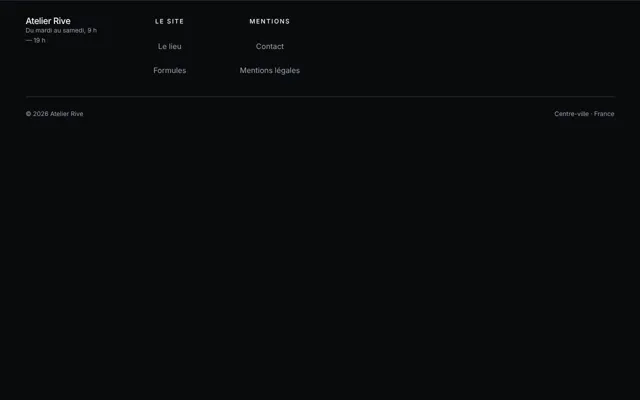 Footer
- The label navigation lines up its links in small, spaced capitals, like a spec sheet. It announces a page that reads like a file.
- The centered hero sets the firm’s name and what it does, in one sentence. Its button leads to the first conversation.
- The statement isolates a single sentence, large: the problem you solve, in the client’s words. It only has strength alone, in the empty space around it.
- The filling numbered list runs through the method, from 01 to 05. On hover, the whole row fills with color: the visitor follows the step they are reading.
- The partitioned figures, denser and more technical, carry the proof: assignments carried out, years in practice, turnaround time for a diagnosis.
- The frameless testimonials give the floor to real clients, named with their consent. A single one reads as the seller’s own claim: you need several.
- The panel contact stands out from the flow: address, phone, email, and the first-meeting button.
- The footer says who you are: the company name, the title and the regional council of the Order for a chartered accountant, the legal notice.
The background chosen is the still image: a single image, taken from a shot the studio films from your description, which leaves all the room to the figures. The Paper texture (see paper texture) lays the fiber of a thick paper over the page, that of a bound report, far from the cold screen of a dashboard.
What the rules say
A consultant has no Order. A chartered accountant in France has one, and a code of ethics that says how they communicate.
The general rule. Article 152 of the code allows promotional actions, provided they give the public useful information. They are carried out with discretion, without harming the independence, dignity or honor of the profession, professional secrecy or fairness toward clients and colleagues. The wording stays decent and restrained, and the content contains no inaccuracy, nothing that could mislead, no comparative element.
Canvassing has been allowed since a 2014 decree, within the same limits.
The title. A chartered accountant can follow their title with the name of the regional council of the Order they belong to (article 153).
What the Paris regional council refuses, as examples:
- calling yourself the “leading network” of consulting and accounting: it is a comparison;
- calling yourself a “certified firm” when the Order issues no certification: the statement misleads.
The scope. A company that hands its bookkeeping to an outside party must hand it to a chartered accountant registered with the Order, the Order points out. A consultant who isn’t registered therefore doesn’t offer bookkeeping on their site.
For everyone. Outside any code of ethics, ordinary law applies: the Paris regional council points out that the ban on unfair commercial practices, in the consumer code, also applies to firms’ communication.
Proof that can be checked
A convincing case study fits in four lines: the starting situation, what you did, the measured result, the time it took. If the client doesn’t want to be named, describe them without identifying them (“an industrial SME with forty employees”), and keep the exact figure.
A chartered accountant is bound by professional secrecy, and article 152 asks them to respect it even in their promotion: get a client’s written consent before citing their name or logo. The same caution applies to a consultant, whose contracts often bind them to confidentiality.
Give each figure its basis. “Average closing time: 45 days” can be checked; “satisfied clients” can’t. And choose real reviews: the article on customer reviews says what the law requires when you publish them.
The “First conversation” button
The hero button leads wherever you want: your online calendar, a number, an email address. Ask for little in the first message: the name, the company, the subject in one sentence.
The mistakes that cost clients
- A promise in figures with no basis: “+30% margin guaranteed”.
- Client logos placed without their consent.
- “Leader”, “number one”: comparisons nothing proves, and that the code forbids chartered accountants.
- Jargon: “holistic performance support” says nothing about what you do on Monday morning.
- No price range, nor duration: the visitor assumes the worst.
- A ten-step method, which nobody will read.
Sources
- French Order of Chartered Accountants (Brittany regional council), Code of ethics of the accounting profession, January 2024 edition
- French Order of Chartered Accountants Paris Île-de-France, Le Francilien, Right to communicate and advertising (2022)
- French Order of Chartered Accountants, What is a chartered accountant?