An art director looking for a photographer for a catalog, a publisher looking for an illustrator, an agency looking for a director for a music video: they open your portfolio between two meetings, with three other tabs beside it. They read almost nothing. They look, they sort, and in less than a minute they know whether your eye fits their project.
The site must show your best work right away, load fast, and say how to reach you.
What the client comes looking for
- Your eye, across a dozen chosen images. A recognizable signature is worth more than an inventory.
- Work close to their commission: portrait, product, architecture, publishing, music video, advertising. Sort by type of commission rather than by year.
- Recent, commissioned work: it says that others have trusted you, and for what.
- Your terms: travel area, timelines, rights assigned, and how you put together a quote.
- A direct contact: email and phone as real links, and your city.
The “Portfolio” layout
This is the layout the studio offers photographers, illustrators and directors: the work fills the screen, the text stays discreet. Here it is from top to bottom:
“Portfolio” layoutBackground: Scroll-scrubbed videoTexture: Dust
 Minimal
 Hero · Top left
 Overflow
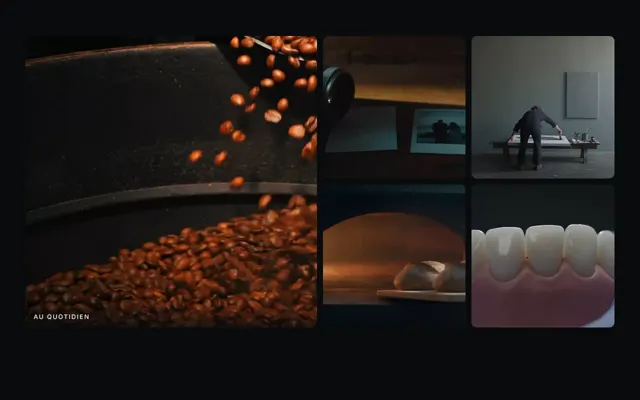 Gallery · Portraits
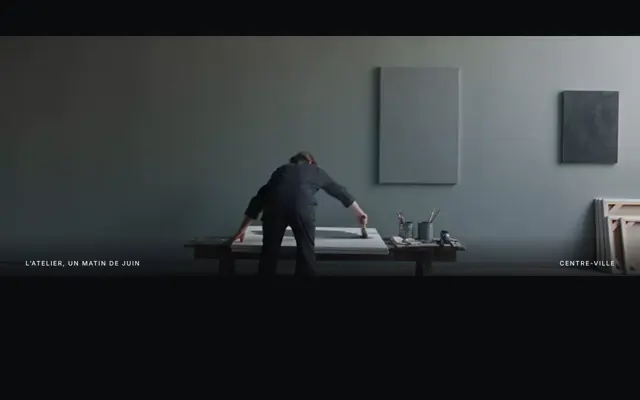 Full frame · Top
 References
 Quote · Wide measure
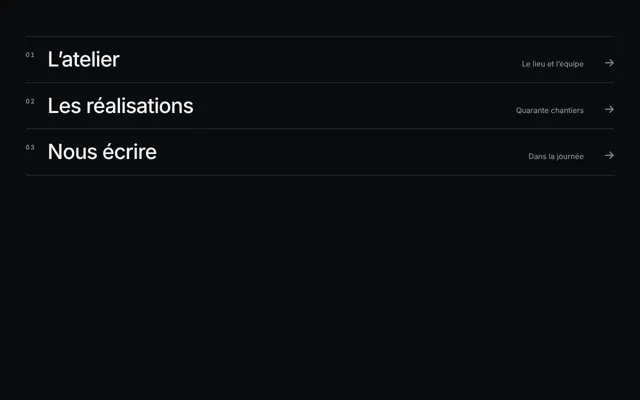 Contents
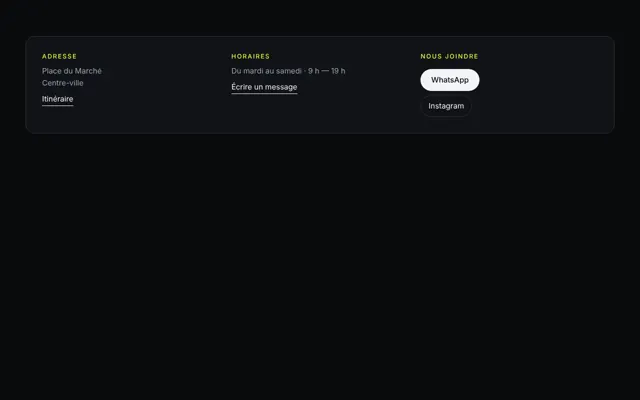 Contact
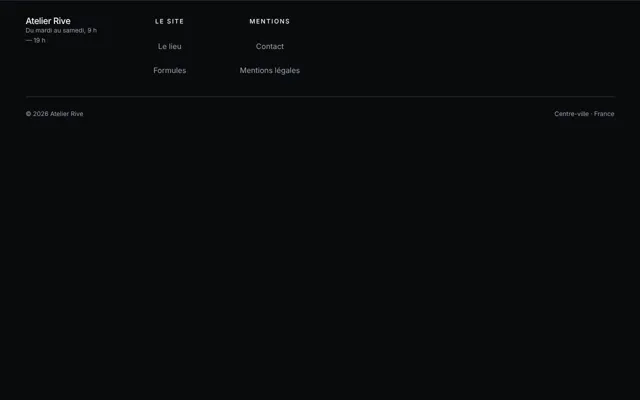 Footer · Giant signature
- The minimal navigation comes down to your name and a menu button: nothing gets in front of the images. It is made for pages with fewer than five sections, which is the case here.
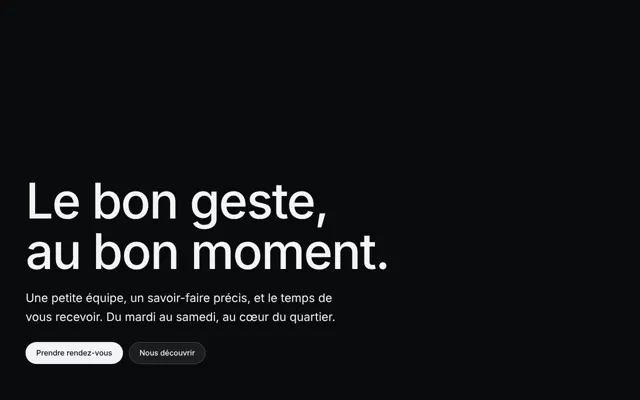
- The top-left hero sets your name and your profession at the top of the screen, like a magazine page, and leaves the bottom to the film.
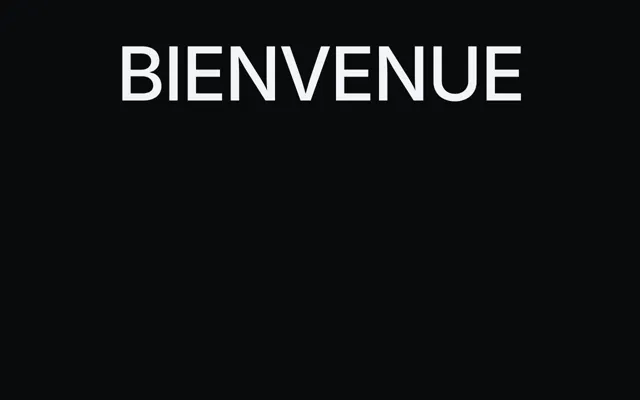
- The overflow writes a giant word, deliberately cut off by the edges of the screen: your name, or your specialty. The reader rebuilds the word, and the page seems bigger than the screen.
- The portrait gallery lines up vertical images, the format of faces, covers and posters.
- The wide-measure quote carries a long sentence without breaking it into six lines: that of a client, a publisher or a critic, with their name.
- The contact brings together email, phone and city as real links.
- The giant signature footer ends on your name in large type, cut off by the bottom of the page.
The background of this layout is the scroll-scrubbed video: the frames of the film advance with scrolling, like a contact sheet scanned with a finger. If the visitor has asked for less animation, the film fades out and its poster stays. This film is a scene created by a video generation model from your description, not one of your images: it sets the atmosphere, and your work stays in the gallery. The texture is dust: fine vertical scratches and a few light specks, like a print taken out of a box.
What the rules say
The people you photograph
In France, a recognizable person must have given their written consent before their image is published, on a website as elsewhere. Their consent to being photographed isn’t enough. The consent states the medium, the purpose and the duration, and a new use requires new consent. For a minor, the parents’ written consent is needed (Service-public.gouv.fr, 2022).
In practice, the release signed for a client’s campaign doesn’t necessarily cover your portfolio. Add a line to your model releases that covers your site and your social networks. In a public place, consent is only required if the person is singled out and recognizable: a crowd where no one is highlighted is exempt, provided people’s dignity is respected and it doesn’t serve a commercial purpose. A portrait taken in the street, however, requires consent. The details are in your site’s photos.
The works you show
Your images belong to you from the moment they are created. But when a client commissions them, they obtain the rights you assign to them in writing, each mentioned separately with its scope, purpose, territory and duration (Intellectual Property Code, article L131-3). If you assign everything, expressly reserve the right to show these images in your portfolio.
Other people’s works count too. Any reproduction of a work without its author’s consent is unlawful (article L122-4): a painting, a poster or a sculpture in the foreground of your image still belongs to its author. The code provides an exception for buildings and sculptures permanently placed on public roads, but excludes it for any commercial use (article L122-5). A recent building at the center of an image that sells your services is worth checking.
Light, signed images
Images are what weighs most on the web: the median mobile home page loads 911 KB of images, out of 2.6 MB in total (HTTP Archive, 2025). A portfolio is made almost entirely of images, and a file straight out of the camera often weighs several megabytes on its own. The steps that lighten it, according to web.dev, Google’s performance site:
- Export at display size. A 1,000-pixel image in a 500-pixel frame weighs twice too much. Very dense screens justify a finer version, which the
srcsetattribute reserves for them. - Choose a modern format. WebP generally compresses better than JPEG, and AVIF goes further in some tests.
- Compress, then check by eye, especially skies and plain backgrounds, where compression shows first.
- Never defer the first image. Lazy loading (
loading="lazy") is made for images further down the page, not for the one on the first screen (web.dev, 2024).
Sign your files too. Google Images can display an image’s creator, credit and rights notice, read from its IPTC metadata or from the page’s structured data, without guaranteeing to do so (Google Search Central, 2026). Fill in at least your name and the copyright notice in your exports, and check that the tool publishing your images doesn’t strip them when compressing.
The mistakes that cost commissions
- Showing everything: forty average images drown the ten best ones.
- Files of several megabytes, which take seconds to appear on a phone.
- A portrait published without a release, or with a release that didn’t cover your site.
- A watermark in the middle of the image: it bothers the eye more than it protects.
- Neither date nor client: nobody knows whether the work is recent, or whether it was commissioned.
- A contact hidden behind three clicks.
Sources
- Service-public.gouv.fr, Image rights and respect for private life (2022)
- WIPO (WIPO Lex), French Intellectual Property Code, consolidated version of March 13, 2025
- HTTP Archive, Web Almanac 2025, Page Weight chapter
- web.dev, Image performance (2023)
- web.dev, Browser-level image lazy loading (2024)
- Google Search Central, Image metadata in Google Images (2026)