
People rarely look for a lawyer for pleasure: a dismissal, a divorce, a lease gone wrong, a relative in police custody. The visitor arrives tense, often in the evening, and asks three questions. Does this firm handle my problem? How much will it cost me? Can I be seen quickly? A site that answers these three questions in a minute has already done half of the first meeting.
In France, a lawyer’s website also follows precise rules, set by the National Bar Council in its national internal rules, the RIN. They fit in a few lines, and they are easy to respect when you know them before writing.
What the client comes looking for
- Your practice areas: what you handle, and for whom (individuals, employees, businesses).
- Who you are: your bar, your background, your languages, your specialization if you have one.
- How you charge: flat fee, time spent, success fee, legal aid accepted or not.
- The first meeting: how to get one, at the office or by video call.
- Where and how to reach you: the address, the phone, the email, as real links.
The “Law firm” layout
The studio offers it to lawyers, notaries and bailiffs: a sober page that states your areas of practice and leads to an appointment.
“Law firm” layoutBackground: Still imageTexture: Paper
 Labels
 Hero · Top left
 Statement · Left aligned
 Numbered list
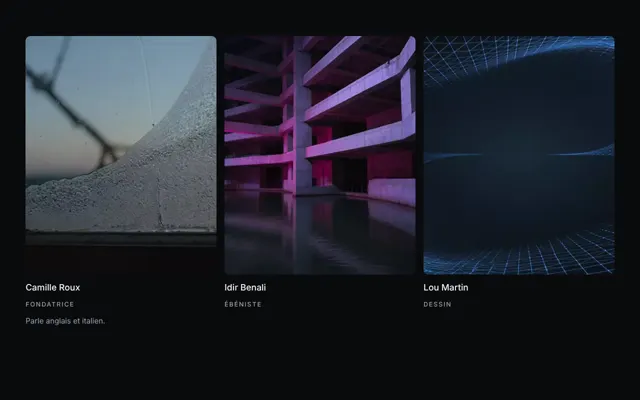 Team
 Timeline
 Accordion
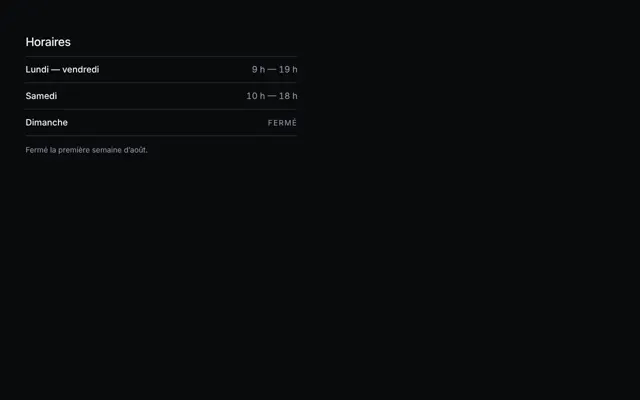 Opening hours
 Form
 Contact · Panel
 Footer
- The label navigation lines up its links in small, spaced capitals, like a spec sheet: practice areas, fees, firm, appointment. The tone of a well-kept file.
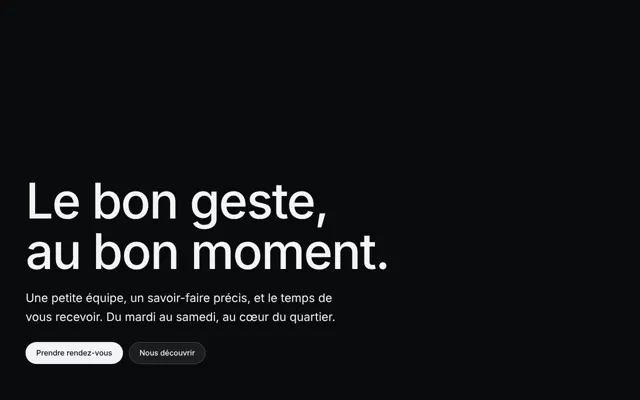
- The top-left hero sets the firm’s name, the bar and a sentence, like a cover page. Its button leads to an appointment.
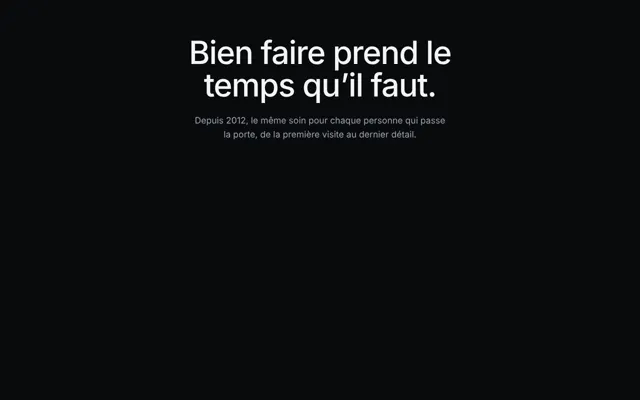
- The left-aligned statement says in one sentence what you do and for whom: “We defend employees, from the termination of the contract to the employment tribunal.”
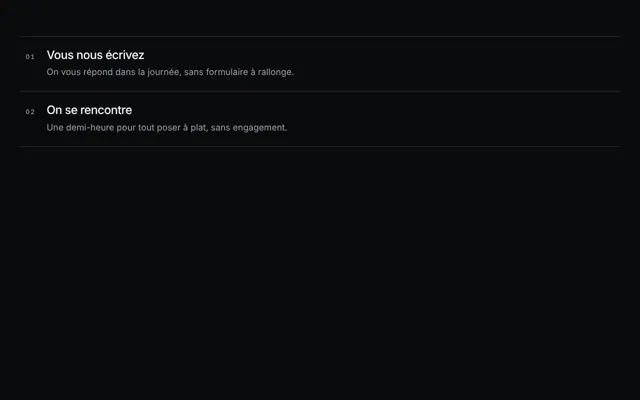
- The numbered list details your practice areas, each with a line of explanation in plain language; three at most are presented as main areas.
- The figures give verifiable markers: the year you were sworn in, the number of lawyers, the working languages.
- The accordion answers the questions that decide a call: how you charge, whether you accept legal aid, how the first meeting goes, at the office or by video call. What to say about fees there is detailed below.
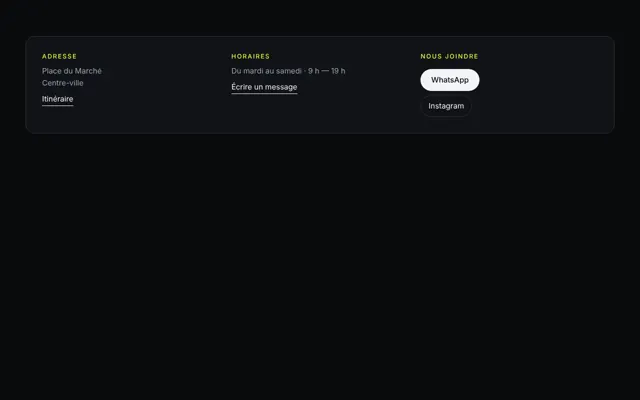
- The panel contact brings together the address, the phone, the email and the bar of registration.
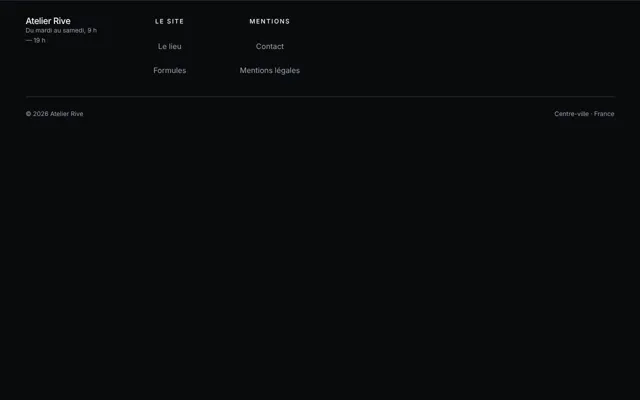
- The footer carries the practice structure, the legal notice and the consumer mediator.
The layout carries no testimonials: for a lawyer, the names of clients fall under professional secrecy (see below). If you add sections in the studio, leave that one aside, or ask your bar before filling it.
The background chosen is the still image: a single image, taken from a shot the studio films from your description, motionless behind the text. It is a created scene: a library, end-of-day light on a desk. The Paper texture (see paper texture) lays the fiber of a thick paper over the page, that of deeds and pleadings.
What the rules say
Article 10 of the RIN governs all of a lawyer’s communication, website included.
What the site must make possible. Stating that you are a lawyer, and making it possible to identify you, locate you, reach you, know your bar, your practice structure and, where relevant, your network. When you describe your services, the information must be truthful.
What is forbidden.
- any false or misleading advertising;
- any comparative or disparaging statement;
- any statement suggesting a structure that doesn’t exist or a qualification that isn’t recognized;
- any reference to roles unrelated to the profession, or to judicial roles.
The words “specialist”, “specialized”, “specialty” and “specialization” are reserved for lawyers holding a specialization certificate. Without a certificate, you speak of main practice areas: three at most per lawyer, and only if they result from actual, regular practice. Any communication about these areas is sent without delay to the bar council.
The site itself. A lawyer who opens a site, or substantially changes it, informs their bar without delay and gives it the domain names. The domain name contains your name or the firm’s, possibly followed or preceded by the word “avocat”. A generic name, evoking the title of lawyer, a field of law or an activity of the profession, is forbidden. The site carries no advertising banners, except the profession’s own, and you are responsible for the links it contains.
Secrecy. The RIN counts clients’ names among the information covered by professional secrecy. It only allows naming them, with their express prior consent, in a response to a call for tenders.
The mediator. Every lawyer who works with individuals states on their site the contact details of the consumer mediator they come under. Forgetting it can bring an administrative fine of up to €3,000 for an individual and €15,000 for a company, the Paris Bar points out.
Notaries and bailiffs. Part of their acts follow a regulated scale of fees. In 2021, the DGCCRF checked 261 practice websites and found pricing information that was rarely complete, often shown before tax when it must be shown tax included (DGCCRF, 2022).
Fees on the page
The RIN requires informing the client of how your fees work as soon as they instruct you, then signing a written agreement with them, except in urgency, force majeure or full legal aid. The site can do it earlier, and that is often what decides the visitor to call.
Say how you charge: a flat fee for simple procedures, an hourly rate for the rest, a possible success fee. The latter only comes as a supplement: setting all your fees on the court outcome alone is forbidden. State whether you accept legal aid. The visitor then knows what to expect, and your first meeting starts with their case.
The “Book an appointment” button
The studio doesn’t take appointments itself. The hero button leads wherever you want: your online calendar, your number, an email address. For a first written contact, ask only for the subject of the request and a way to call back: the account of the case will come at the office.
The mistakes that cost clients
- “Divorce specialist lawyer” without a specialization certificate.
- A generic domain name, like “divorce-lawyer-city”.
- Client logos or reviews signed with their names.
- A success rate: unverifiable, and always compared to someone.
- No idea of the price, nor of the billing method.
- No bar on the page, or an address that can’t be found.
Sources
- National Bar Council (CNB), National internal rules of the legal profession, consolidated version of July 7, 2026
- Service-public.fr, How is a lawyer paid? (checked August 1, 2025)
- Paris Bar, Consumer mediation: what are your obligations? (2021)
- DGCCRF, Notary and bailiff fees: are you well informed? (2022)