
An industrial company’s website has two visitors. The buyer, first: a purchasing department, an engineer, a client company drawing up its shortlist of suppliers and wanting to know, quickly, what you can make, with which machines, in what quantities, under which standards. The candidate, second: a technician, a machine setter, a welder, checking that the company is serious and that it is hiring. Both look for facts, and style comes after.
What the client comes looking for
- The know-how: the processes (machining, sheet metal, injection molding, welding, assembly), the materials, the tolerances held.
- Capacity: the machine fleet, maximum dimensions, batch sizes, annual volumes.
- Certifications that are currently valid, with their certifying body.
- The sectors served and references, when your clients agree to be cited.
- How to send you an inquiry: the drawing formats accepted, the response time, a named contact.
- Open positions, for candidates.
The “Industry” layout
The studio offers it to factories, subcontractors and technical offices, where capacity comes before style.
“Industry” layoutBackground: Looping videoTexture: Halftone
 Labels
 Hero · Bottom left
 Numbers · Partitioned
 Split · Media at two thirds
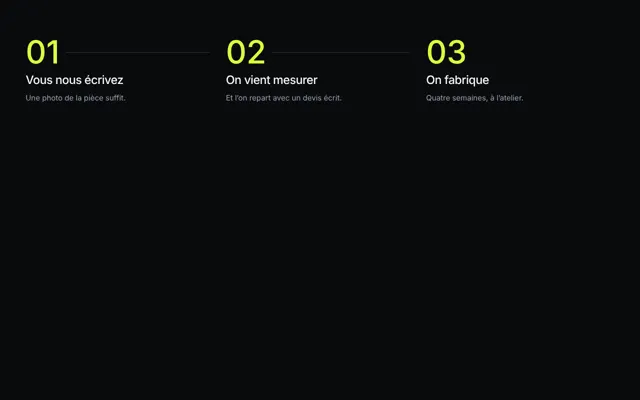 Steps · Linked
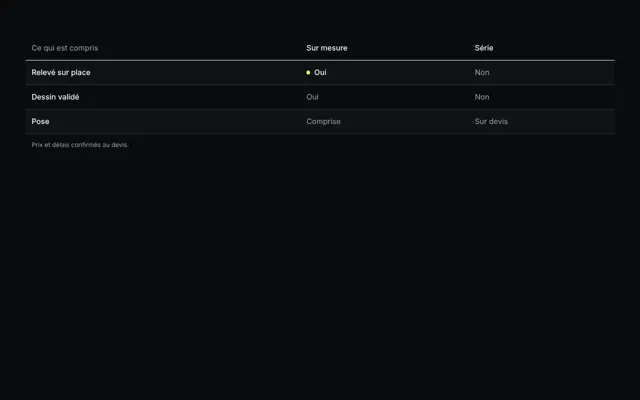 Table · Striped
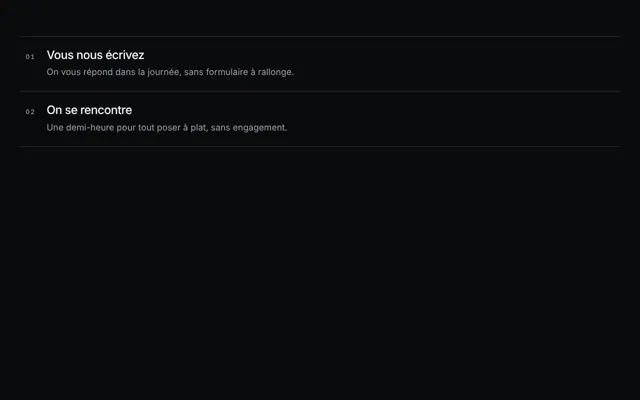 Numbered list · Filling
 References · Between rules
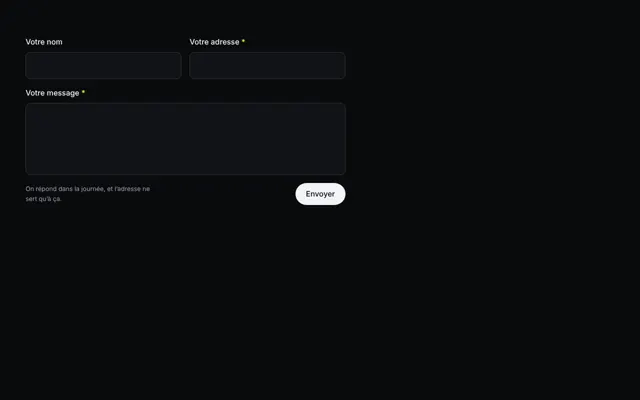 Form · Two columns
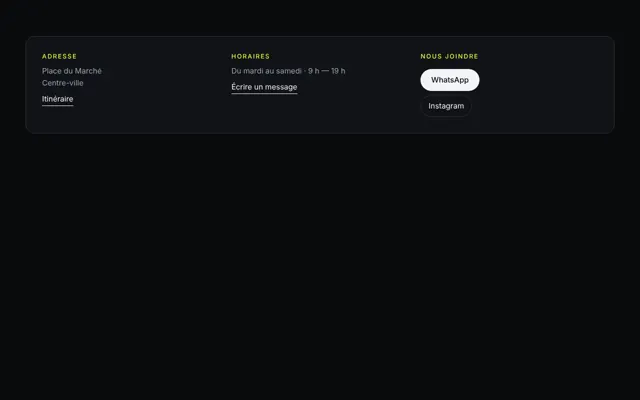 Contact · Panel
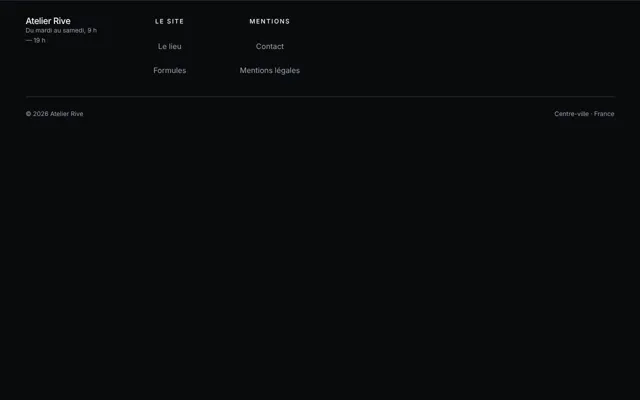 Footer · In columns
- The label navigation writes its links in small, spaced capitals, like a spec sheet: know-how, capacity, certifications, careers, contact.
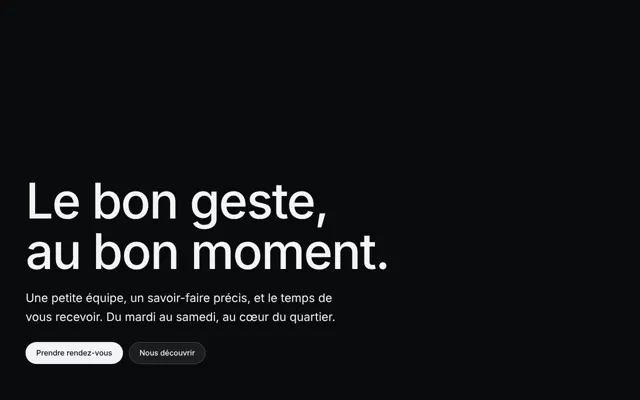
- The bottom-left hero sets the name and what you make, in one sentence, at the bottom left of the video. Its button leads to the inquiry.
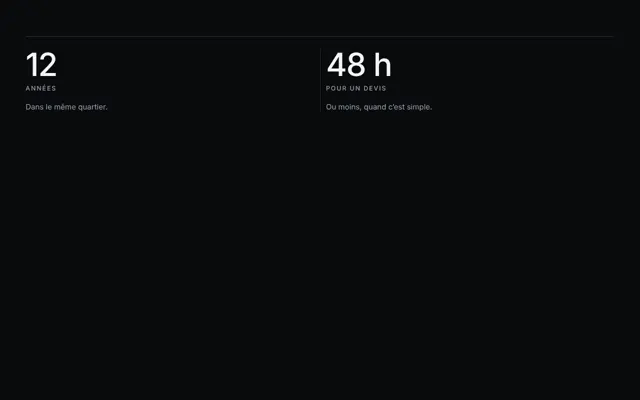
- The partitioned figures, denser and more technical, line up the proofs: the number of machines, parts produced per year, employees, the tolerance held.
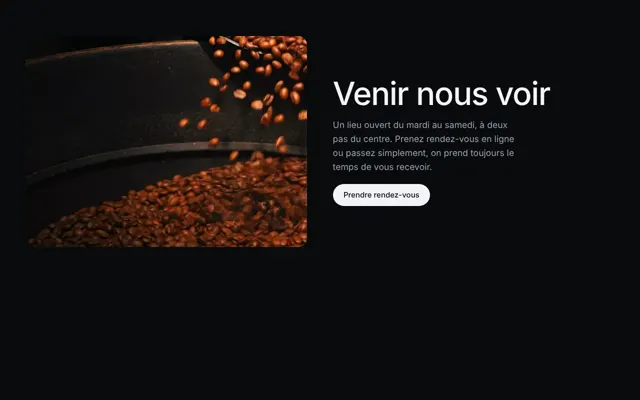
- The split, media at two thirds, gives room to the image, and the text becomes a caption: the robotic cell, the press, the finished part.
- The filling list runs through your processes or the steps of a project, from 01 to 05. On hover, the row fills with color from end to end.
- The before / after shows two states of the same frame, separated by a handle you drag: the raw part and the machined part, the surface before and after treatment. The framing must be identical, otherwise the comparison lies.
- The panel contact stands out from the page: the factory address, truck access, the sales department’s phone, the email.
- The columned footer holds the know-how, the certifications, careers and the legal notice.
The background is a looping video, which plays on its own while the slices rise: the simplest and sturdiest of behaviors. The halftone lays thin horizontal lines over it, like a control monitor: a strong choice, which embraces the technical side. The video is a scene shot by a model from your description, and doesn’t show your workshop: your real machines go in the split and the before / after.
What the rules say
Certifications
ISO writes the standards, but certifies no one. Certification bodies issue the certificates, and ISO doesn’t allow its logo to be used to signal a certification. A company therefore can’t call itself “certified by ISO” (ISO, 2026). Write instead “ISO 9001 certified by” followed by the name of the body, without the ISO logo.
A certification issued by an accredited body can be checked online, in the CertSearch database that ISO’s page points to, or with the body itself. Make this check easy: give the certificate number, the body and the expiry date. A sixth edition of ISO 9001 came out in 2026 (ISO, 2026): state the edition that appears on your certificate.
Above all, never leave an expired certification online. During an investigation, the DGCCRF found products sold with the “Origine France Garantie” label when the body’s certificate had expired: the products were indeed French, and using the label was still an offense (DGCCRF, 2025). The day a certificate lapses, the logo leaves the site.
“Made in France”
The same investigation checked 1,499 businesses in 2023, manufacturers included: 16% had irregularities, mostly unjustified origin claims, misleading symbols such as the French flag, and labels used without authorization. To claim French manufacturing, you must know the origin of the products and their components; a change of supplier can make a claim false that used to be true (DGCCRF, 2025). Keep the proof, and reread the page when the supply chain changes.
Talking to buyers
A buyer qualifies several suppliers at once. Give them capacities with their units: maximum travel, part size, usual batch sizes, typical lead times. The Nielsen Norman Group, the reference in web usability, advises businesses that work on quotes to show a few typical cases rather than a “contact us”: at this stage, the buyer is looking for an order of magnitude to shorten their list (Nielsen Norman Group, 2006).
The studio doesn’t receive inquiries itself. The button leads wherever you want: the sales department’s address, which receives drawings as attachments, or your supplier portal. Write the formats accepted and the response time you keep to. For other questions, the contact block gives the switchboard and an email address, as links that open with a tap. For copy an engineer reads quickly, see how to write for the web.
Hiring from the site
A candidate opens the site before applying. A “We’re hiring” section with real, dated positions tells them the company is alive. The button leads to the full job offer or to the HR address.
The offer is written on the skills for the job alone. The French Labor Code forbids mentioning origin, sex, age, family situation, health or disability, among other criteria. The Defender of Rights cites forbidden examples: “looking for male site manager”, “aged 25 to 35”. An age limit is only allowed when a text permits it, as for apprenticeships. A general statement, such as “diverse applications welcome”, remains possible (Defender of Rights). In French, write the job title in both genders: “régleur ou régleuse”.
The mistakes that put a buyer off
- An expired certification logo, or the ISO logo itself.
- “Contact us” in place of every capacity.
- Photos of machines taken from a catalog from a manufacturer.
- A French flag on products made elsewhere.
- Job offers filled six months ago.
- No named contact, only a generic address.
Sources
- ISO, Certification (page viewed October 2026)
- ISO, ISO 9001:2026, Quality management systems (edition 6, 2026)
- DGCCRF, Inspection of origin claims on non-food products (March 2025)
- Nielsen Norman Group, Show Prices for Common Scenarios (2006)
- French Defender of Rights, Writing job offers (factsheet, distributed by DREETS Normandie)