
On a nonprofit’s website, people come to understand a cause, then decide whether to get involved: join, give, come and help on a Saturday morning. Or simply check that the organization really exists before entrusting it with their name, their time or their money. The visitor is well-disposed, but cautious. They look for what you do, who you are, and what becomes of what people give you.
What the client comes looking for
Here, the client is a future member, a volunteer, a donor or a partner. The questions, in order:
- The cause, in one sentence: for whom, for what, where.
- What you actually do: the actions, the meetups, what they have achieved.
- Who you are: the board, the volunteers, the legal status, the registration number.
- How to get involved: join, give, help. And what membership costs.
- What becomes of the money: what dues and donations pay for, and whether a donation qualifies for a tax reduction.
- How to reach you, and where to find you.
The “Nonprofit” layout
The studio offers it to clubs, NGOs and collectives: the cause comes first, membership next.
“Nonprofit” layoutBackground: Still imageTexture: Paper
 Full bar
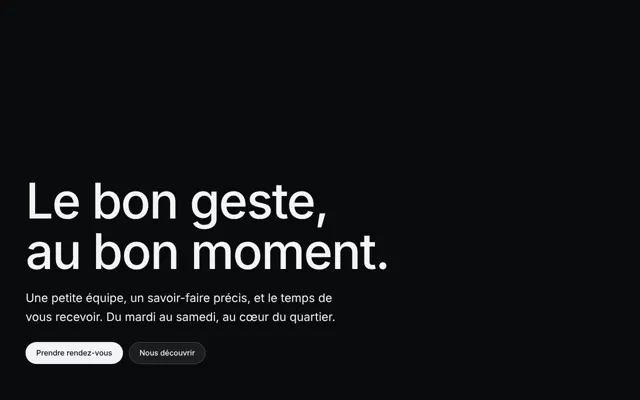 Hero · Centered
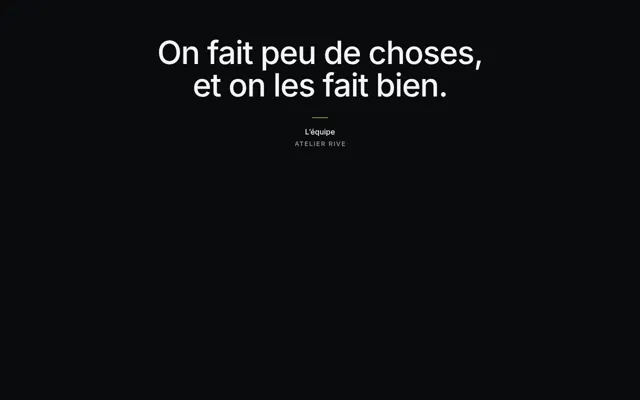 Quote
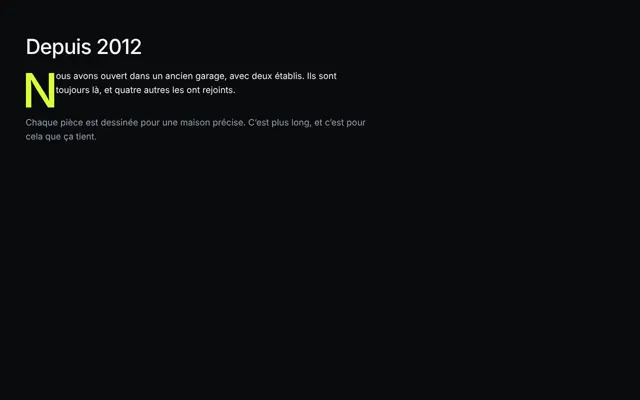 Text · Drop cap
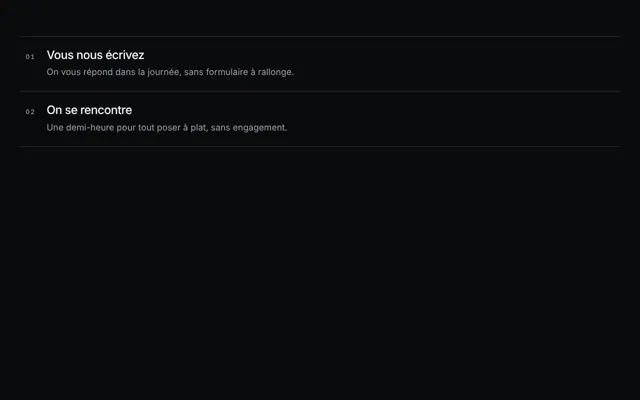 Numbered list
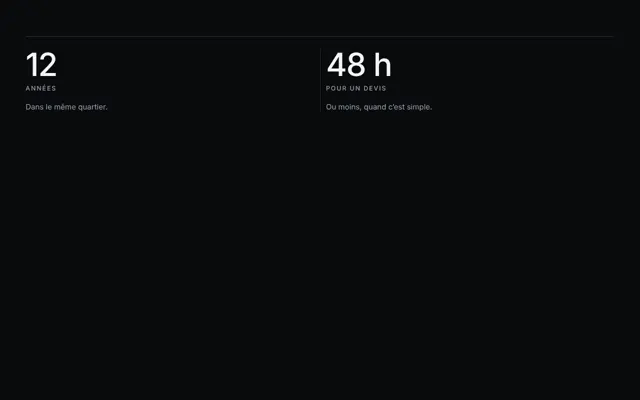 Numbers · Counted
 Team · Circles
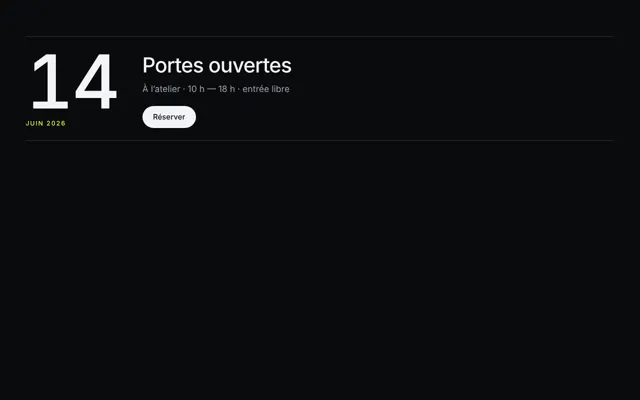 Event · Inline
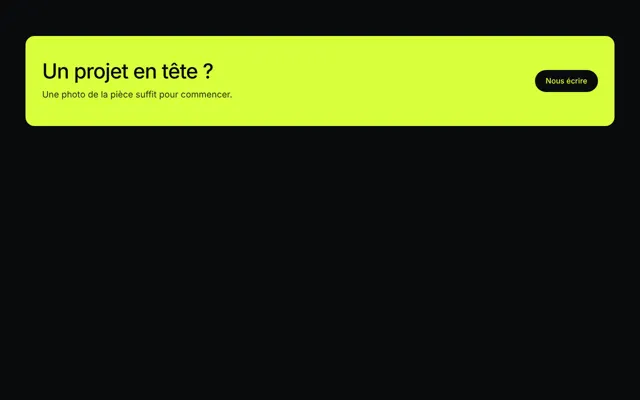 Call to action · Accented
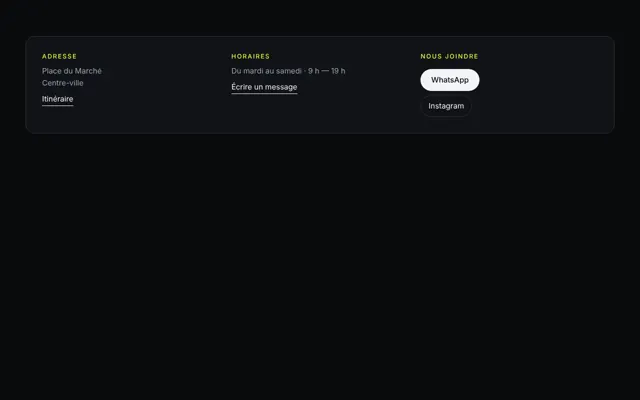 Contact
 Footer
- The full bar has an opaque background: it stays readable from the first screen, whatever the image beneath.
- The centered hero, steady, almost institutional, carries the name, the cause in one sentence and the button.
- The quote sets a full-width sentence, with its attribution: that of a volunteer, a person helped, the founder. A real person, who has given their consent.
- The numbered list counts off, from 01 to 05, what you do: outreach rounds, classes, work sites, drop-in hours, outings.
- The figures line up the proofs: a number, a word, a note. Meals served, volunteers, years of existence, each with its date.
- The testimonials give several voices, from those who help as well as those who are helped.
- The contact brings together the address of the premises, the drop-in hours, the phone and the email as real links.
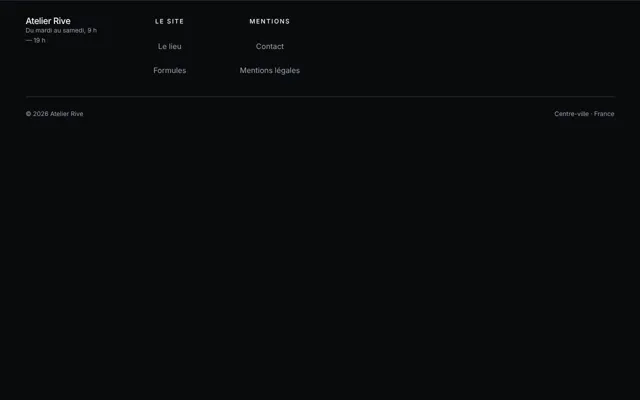
- The footer says who you are and carries the legal notice: that is where the registration number and the legal notice live.
The background is a still image, nothing more: when the subject deserves to be looked at rather than crossed, an image holds better than a film. Paper lays the fiber of a thick paper over it: the site leaves the glass of the screen and recalls the flyer, the poster, the newsletter slipped into mailboxes. This layer darkens the image a little; on an already dark palette, its intensity is lowered.
What the rules say
Who you are: the RNA number
In France, a declared association receives a receipt from the registry within five days of filing a complete application. This document carries its number in the national directory of associations: the letter W followed by nine digits. In Alsace-Moselle, the association registers with the court’s register of associations, under other rules (service-public.fr, 2024).
Write this number in the footer and in the legal notice. It is the identifier partners ask you for, and the tax authorities accept it for declaring donations. Like any site, a nonprofit’s site also says who publishes it and who hosts it: what a legal notice must contain.
Donations and tax receipts
This is where caution is needed. Being a declared association is not enough to issue tax receipts. You must meet the conditions of public interest: a non-profit activity, disinterested management, action that doesn’t benefit a narrow circle of people (service-public.fr, 2026).
When these conditions are met, a donor who pays French income tax deducts 66% of their donation from their tax, up to 20% of their taxable income. For 2026 donations to bodies that provide meals, care or housing to people in difficulty, or that help victims of domestic violence, the rate is 75% up to €2,000 of donations in the year, then 66% beyond (service-public.fr, 2026).
When in doubt, the association can ask the tax authorities in advance: this is the patronage tax ruling. The authorities have six months to answer, and silence counts as approval. An association that receives a negative answer and issues receipts anyway faces a fine equal to the tax reduction wrongly granted to its donors (service-public.fr, 2025). Finally, every body that issues receipts declares each year to the tax authorities the number of receipts issued and the amount of donations concerned (Bercy infos, 2026).
On the site, only write “66% tax-deductible donation” if you can issue the receipt. Otherwise, simply say what the donation will pay for, without mentioning tax.
The “Join” or “Donate” button
The studio collects neither dues nor donations. The button leads to the tool the association already uses: its online membership platform, its donation form, the treasurer’s address. Choose the main gesture, join or give, for the hero and the navigation; the other finds its place further down, in the list or near the contact.
Write the amount of the membership fee, and what it gives under your statutes: the vote at the general meeting, insurance during activities, the newsletter. A future member hesitates less when they know what they are committing to. For questions from volunteers and partners, the contact block gives an email address and a number, which open with a tap. For a nonprofit that organizes a festival or a day event, the page of an event follows other rules.
The mistakes that discourage goodwill
- A vague cause: three paragraphs of history before saying what you do.
- Undated figures: a thousand meals served, but in what year?
- “Tax-deductible donation” written without being able to issue a tax receipt.
- Photos of people helped published without their consent.
- A contact address that belongs to a former president and that nobody checks anymore.
- A calendar stuck on the last event two years ago.
Sources
- Service-public.fr (Associations), Initial declaration of an association (checked November 5, 2024)
- Service-public.fr, Income tax: donations to associations and public-interest bodies (checked April 15, 2026)
- Service-public.fr (Associations), Public-interest body: when to use a tax ruling? (checked November 19, 2025)
- Bercy infos, Associations: remember to declare the donations received (September 2026)