
Handing your apartment, your restaurant or your offices to an interior designer or a decorator means handing over a budget and months of work. The visitor takes their time. They look at the projects, look for their own case among them, a two-room apartment, an open kitchen, a shop, then check how you work, what it costs and whether you are insured.
The site shows them the transformation, then answers their questions about method and trust.
What the client comes looking for
- Completed projects, in real photos, with the state before.
- Your method: the steps, from the first meeting to the end of the works.
- What you take on: advice, plans, choosing contractors, supervising the works, and what you hand to others.
- Your fees, or how they are calculated.
- Your qualifications and your insurance.
- The area where you work, and how to book a first meeting.
The “Interior design” layout
This is the layout the studio offers decorators and interior designers, whose subject is transformation. Here it is from top to bottom:
“Interior design” layoutBackground: RevealTexture: Grain
 Anchored
 Hero · Top left
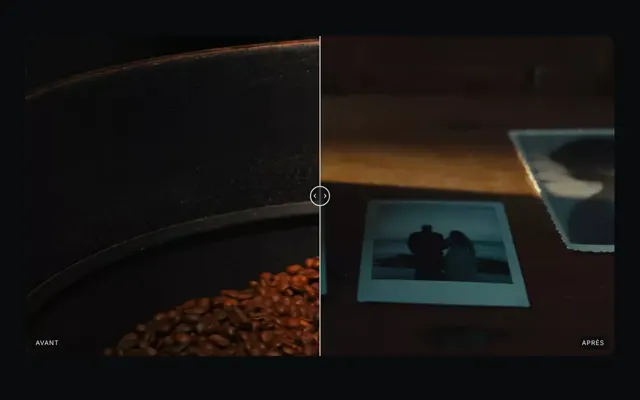 Before / after
 Gallery · Mosaic
 Statement
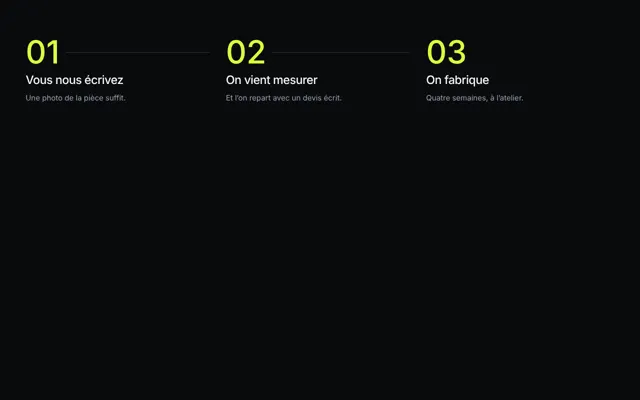 Steps
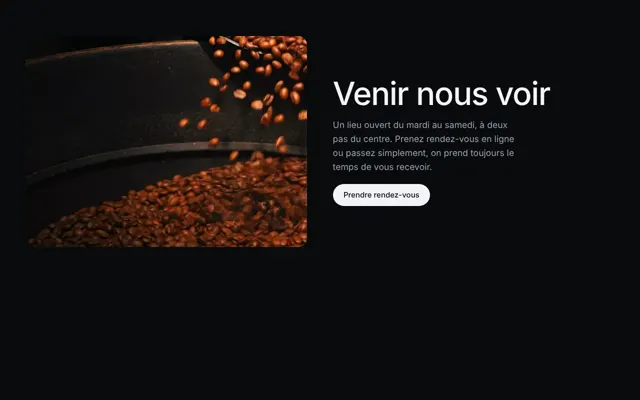 Split · Overlaid text
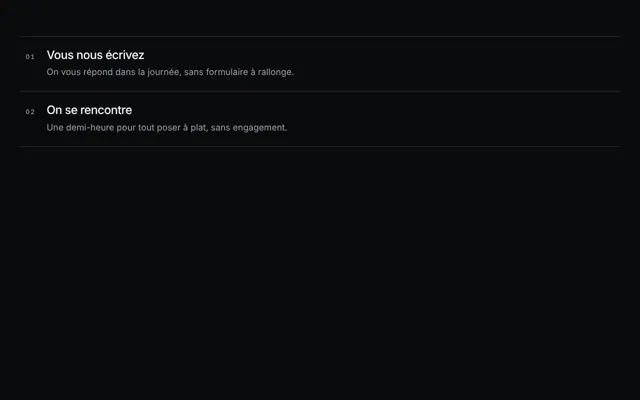 Numbered list
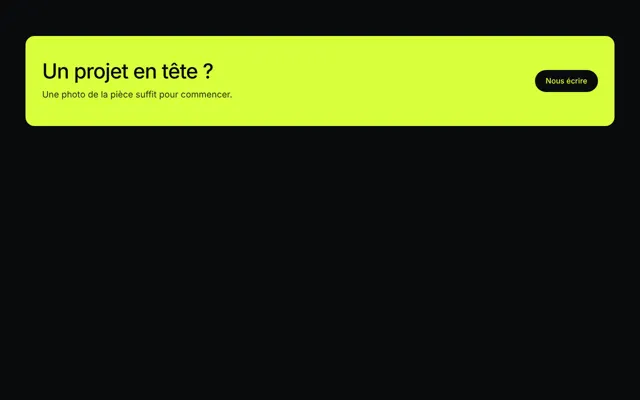 Call to action · Boxed
 Contact · Panel
 Footer
- The anchored navigation is transparent over the hero, then closes as you scroll: it leaves all the room to the opening image.
- The top-left hero sets your name and a sentence at the top left, like a magazine, and leaves the bottom of the screen to the image.
- The before / after comes right away: two states of the same room, separated by a handle the visitor moves. The two photos must have exactly the same framing, otherwise the comparison lies.
- The mosaic gallery arranges your projects in an irregular grid. It needs 5 or 9 images.
- The statement gives your approach in a single sentence, large.
- The numbered list runs through the steps of your assignment, from 01 to 05, separated by rules.
- The panel contact stands out from the flow, with the first-meeting button.
- The footer says who you are and carries the legal notice.
The background chosen is the reveal: two states of the same scene, and the pointer pierces the top one to show the other, like a room being transformed. On a touch screen, the top image stays whole. This scene is created from your description: it announces the subject, and your real projects go in the before / after and the gallery. Grain, a film noise, breaks up the flat areas of a generated image.
What the rules say
The title of architect is protected
In France, the title of architect belongs to people registered on the regional roll of the Order of Architects. The law of January 3, 1977 on architecture also punishes anyone who adds to their name terms likely to make the public believe they are an architect: the penalty is that for usurping a title, a year in prison and a €15,000 fine (Order of Architects, 2019).
The term “interior architect” is defined by no text. The Ministry of Culture pointed this out in 2025: the 1977 law doesn’t make it possible to recognize this title, and the expression creates a risk of confusion with the regulated profession (Ministry of Culture, 2025). At the Order’s request, the DGCCRF checked interior designers’ websites, looking for usurpation. It found none, and points out that usurping the title can also be a misleading commercial practice (DGCCRF, 2018).
On your site:
- always write “interior designer” or “decorator”, never “architect” alone, neither in the page title nor in a signature;
- an architecture graduate who isn’t registered with the Order can call themselves “holder of the architect’s diploma”, followed by the acronym of their diploma (Order of Architects, 2019);
- cite your qualifications and your school as they are.
The building permit sets another limit. Using an architect is the rule for the plans of a permit, notably for a company; an individual is exempt up to 150 m² of floor area, and a prior declaration never requires one (Service-public.fr, 2026). If you work with a registered architect for these files, name them.
Insurance, as soon as there are works
The project manager is one of the builders who must take out ten-year insurance before the works begin, and only the works declared to the insurer are covered (Service-public.fr, 2026). If you design and supervise works that touch the structure, it concerns you. For a decoration advice assignment, check with your insurer what covers you.
The DGCCRF lists professional insurance among the information to give or make available to the client before the contract, with the insurer’s name and the geographic coverage. When the price can’t be set in advance, the client can ask how it is calculated, or for a detailed quote (DGCCRF, 2026). One line in the contact or the footer is enough for the insurance; a sentence about your fees saves many calls.
Project photos
The visitor judges on the images: they must tell the truth.
- Separate what is built from what is planned. A 3D rendering is a project image: caption it as such. French consumer law counts as misleading anything that deceives about the professional’s abilities (DGCCRF, 2025).
- Keep the same viewpoint for before and after: the handle compares two photos taken from the same spot.
- Hold the rights: the photographer’s consent for their images, and that of the owners, whose home it is.
- Caption: the city rather than the address, the floor area, what you did.
The mistakes that cost projects
- “Architect” alone, in a title, a slogan or a signature.
- 3D images presented as completed jobs.
- Photos from other firms or from magazines.
- No trace of insurance, when you supervise works.
- Fees nowhere to be found: at least say how they are calculated.
Sources
- French Order of Architects (Grand Est regional council), Use of the title: texts and conditions (2019)
- French Ministry of Culture, answer to written question no. 7854 on the interior architect, National Assembly (Official Journal of September 9, 2025)
- DGCCRF, The architect qualification on the internet (2018)
- Service-public.fr, When must you use an architect? (checked September 2026)
- Service-public.fr, Builders’ ten-year guarantee (checked April 2026)
- DGCCRF, Pre-contractual information (2019, updated 2026)
- DGCCRF, Misleading commercial practices: how to recognize them (2025)