
An agency’s website receives two very different visitors. The buyer or tenant has already seen your listings on a portal: they come to check that the agency exists, that it knows the neighborhood, and what its fees are. The seller, for their part, is hesitating between three agencies before signing a mandate: they want to know who they are entrusting their property to, how you will show it, and what you will take.
Both decide quickly, on a phone, and both judge on details: a dark photo, a fee scale nowhere to be found, a property sold six months ago still online.
What the client comes looking for
- The properties, or the shortest path to them.
- The fees: your fee scale, and who pays them.
- Your area: the neighborhoods, the towns, the types of property you know.
- Reliability: the professional license, the guarantee, the team, the years in business.
- The contact: getting a property valued, visiting, calling.
The “Real estate” layout
The studio offers it to agencies, developers and property finders, for whom places are seen in large format.
“Real estate” layoutBackground: Scroll-scrubbed videoTexture: Vignetting
 Anchored
 Hero · Bottom left
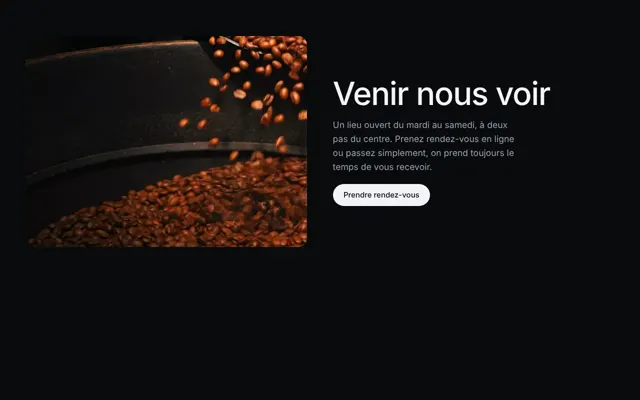 Split · Media at two thirds
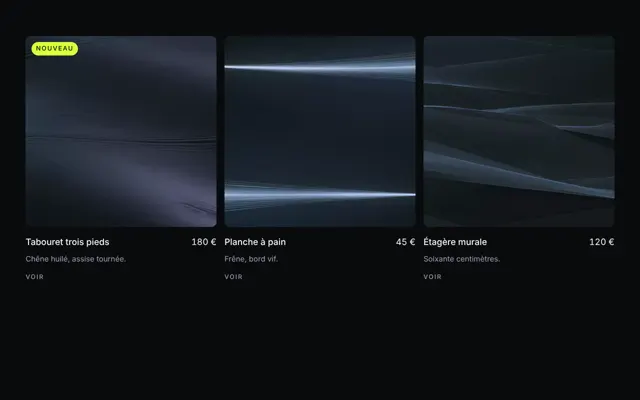 Products · Large images
 Gallery
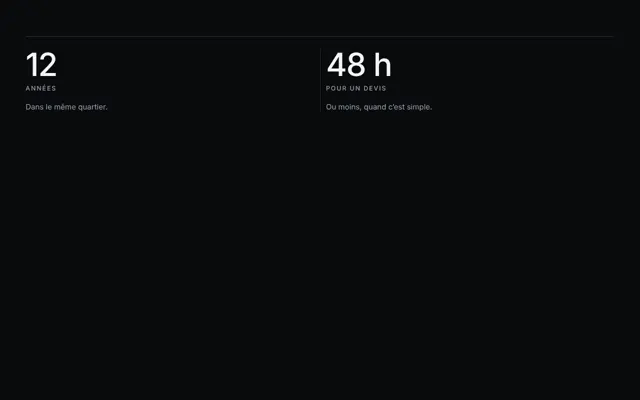 Numbers · Counted
 Before / after
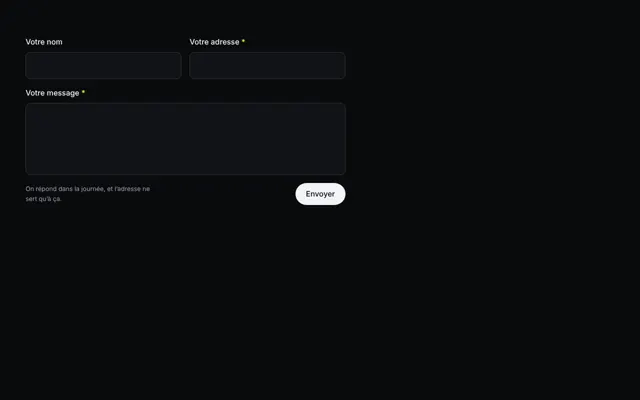 Form · Two columns
 Contact · Panel
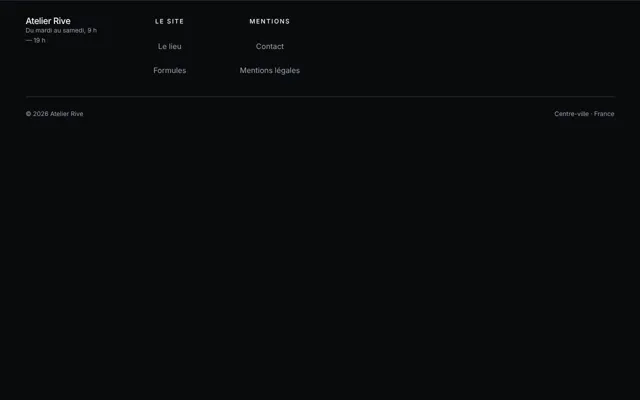 Footer · In columns
- The anchored navigation stays transparent on the first screen, then closes into a bar as you scroll: the video takes up all the space, and the links stay within reach.
- The bottom-left hero sets the agency’s name and a sentence in the corner where the image breathes. Its button leads to the properties or the valuation.
- The split, media at two thirds, gives room to the image and leaves the text the role of caption: an interior, a street in the neighborhood, the agency’s storefront.
- The gallery shows real photos: properties you hold the mandate for, the neighborhood, the team.
- The figures give markers that can be checked: years in business, towns covered, number of negotiators.
- The before, after compares two states of the same frame, separated by a handle you drag: a renovation, a staging. The two views keep exactly the same framing, otherwise the comparison lies.
- The panel contact stands out from the flow: the address, the hours, the phone, the valuation.
- The columned footer holds what the law requires to be displayed: the professional license, the guarantor, the mediator, the fee scale, the legal notice.
The background chosen is the scroll-scrubbed video: the frames of the film advance with scrolling, like a tour you lead yourself. It is the most spectacular and the heaviest background: a small ring shows what is left to load. The film is a scene created by the studio, from your description: a door opening onto an empty room, light crossing an apartment. It doesn’t represent any of your properties, and must never pass for a listing. The Vignetting texture (see vignetting) darkens the edges of the screen and brings the eye back to the center: it gains contrast for the text without touching the image.
What the rules say
The professional license. In France, the Hoguet law reserves the activity to holders of a professional license, issued for three years by the chamber of commerce and industry, with a financial guarantee and professional liability insurance. Your business documents carry the license number and place of issue, the name and address of the company and, where relevant, those of the guarantor. In its 2020 investigation, the DGCCRF found few websites that displayed all the legal information, license included.
The fee scale. Since the order of January 10, 2017, amended on January 26, 2022, it displays for each service a maximum price including tax, and says who pays it. Ranges are not allowed, and tiers must state whether they add up. Online, the DGCCRF requires the fee scale to be reachable in two clicks at most from your site, for example through a “fees” tab on the home page, and every listing published online to carry a visible link to it. Failure can bring an administrative fine of up to €3,000 for an individual and €15,000 for a company (DGCCRF, 2023).
Sale listings. When the buyer pays the fees, the listing gives their share as a percentage of the price excluding fees, shows the price including fees first, then the price excluding fees. When the seller alone pays them, only the price excluding fees appears. The split is always stated.
The energy label. A listing published online shows, readable and in color, the home’s energy and climate classes on the A to G scale. It carries the statement “home with excessive energy consumption” for a home rated F or G, and the estimated amount of annual energy spending, with the reference year for prices (Service-public.fr, 2026). A listing marked “EPC in progress” doesn’t meet this rule, the DGCCRF notes.
What the DGCCRF penalizes. Of 1,006 businesses checked in 2020, 62.5% had at least one irregularity (DGCCRF, 2022). Among the misleading practices found: a sold property left online to look active, the word “sold” on a property sold by a competitor, “exclusive” on a simple mandate, “new” on a listing several months old, and “agency fees included” when the seller alone pays.
Properties, where they already live
The studio builds a page that presents the agency. Your listings stay in the tool that already publishes them, your transaction software or your storefront on a portal, and the “See our properties” button leads there. The fee scale, however, belongs on your site: an “Our fees” link in the navigation and in the footer, to the full scale, meets the two-click rule. You can also write it on the page itself, in rows, service by service.
For the gallery, the rules of a good website photo count double: daylight, tidy rooms, straight framing.
The mistakes that cost mandates
- A fee scale nowhere to be found, shown before tax, or “depending on mandate”.
- “Agency fees included” on a property whose seller alone pays the fees.
- Listings without an energy label, or with a class given by default.
- A sold property left online to pad the numbers.
- An “after” renovation retouched or virtually furnished without saying so.
- The professional license missing from the site, or out of date.